I’m happy to be writing a series of blog posts about my great-grandparents, Ole Olsen and Konstanse Fyhn. This first part of the story is a look at my great-grandfather, Ole Kristian Kaspersen Olsen, including his emigration from Norway, his eventual settlement in the Bella Coola Valley with his two brothers Ingvald and Paul, and his marriage to my great-grandmother, Konstanse Fyhn, in 1914.
By October of 1912, my great-grandfather, Ole Kristian Kaspersen Olsen, was living in the Bella Coola Valley. He and his younger brother, Ingvald, had settled in Hagensborg, the Norwegian community that had been established approximately 20 kilometres east of the Bella Coola townsite. Ole and Ingvald’s younger sibling, Paul, had joined his brothers by 1913. Prior to his arrival in Hagensborg, Ole had left Norway, landed in New York, and lived in Minnesota for about a year. In the early 1900s, Ole’s two elder sisters, Konstanse and Eleonora, had immigrated separately from the family’s home in Helgeland, a district in the Nordland County in northern Norway, to Minnesota, where large numbers of Norwegians had been settling since the 1860s.1
The 1910 US Census indicates that Ole’s eldest sister, Konstanse, was the first of the family to leave, emigrating from Norway in 1901. She married Iver Bottolfson in 1905, and settled in Freeborn County, Minnesota. The 1920 US Census shows that Nora immigrated next in 1906, likely to join her sister. In 1908, Nora married Mandius Monson in Freeborn, and remained there until her death in 1948. Both Bottolfson and Monson were American born sons of Norwegian immigrants. It’s likely that Ole joined his sisters and their families with thoughts of starting a farm of his own in Minnesota.
Ole was the second son in the large Kaspersen family. It would have been expected that his elder brother, Arthur, would inherit the entirety of the family’s farm. Many parts of Norway are dominated by mountains, with only a small portion of the country suitable for farming. At the start of the 20th century, Norway was one of the poorest countries in Europe.2 Poverty and a lack of land opportunities, combined with the odel system of land tenure in Norway, which dictated that only the oldest son – the “odelsgutt” – inherited the farm, saw many younger sons immigrating to ‘Amerika’.3

A relative in Norway tells me that even two generations earlier, Ole’s own maternal grandfather had wanted to emigrate from Norway:
“Erik Pedersen was born in Lom in 1824 and died in 1887. His family tried to move to Amerika but could not afford it. He and his brother Johannes walked then to Helgeland [a journey of hundreds of kilometres]. Erik settled down on a small island and built a small farm. Living off fishing and the small farm. Lom is a mountain village. The change was enormous.”4
Hundreds of thousands had left Norway for North America by 1920.5 This mass migration brought many Norwegian immigrants to the American mid-west where land was readily available, especially after 1862, when the United States Homestead Act allowed newly arrived immigrants to become land owners. Applicants could become owners of 160 acres for just an $18 filing fee if they moved onto the land, built a home there, and farmed the property for five years.6
Despite the availability of land and the relatively low cost of becoming a land owner, some immigrant settlers, including a group of Norwegians in the mid-west, were not content in the United States. “Some had lost their farms, others were tired of the frigid prairie winters and the blazing hot summers.”7 A severe economic depression coupled with challenges to religious freedoms, led the group of Norwegians to select their pastor, Rev. Christian Saugstad, to look for a new place to start a settlement. Ideally, the group wanted the geography of the new settlement to be more like their homeland, as “they missed the comforting backdrop of enclosing mountains and the moderating presence of the ocean.”8
Articles written by Bernard Fillip Jacobsen initially led Saugstad to the Bella Coola Valley.9 Jacobsen was one of the first white settlers in the area. Seeing beauty and potential in the land, Jacobsen not only encouraged the B.C. government to settle the Bella Coola Valley, but he also submitted articles praising the valley to Norwegian language newspapers in the United States. It was these articles, in which Jacobsen compared the coast of British Columbia to that of Norway, and indicated that “the climate, soil, and lifestyle [of the Bella Coola Valley] would be ideal for Norwegians”10 that drew the attention of Saugstad.
After visiting the valley, liking what he saw, and then making arrangements with the provincial government to reserve land for the formation of a colony, Saugstad led the first group of about 85 Norwegians to the Bella Coola Valley in 1894. Under the terms negotiated with Colonel James Baker, the Provincial Secretary and Minster of Education, Immigration and Mines, each man was to receive 160 acres of free land after five years of occupancy, if he could prove $5 per acre in improvements.11
Before arriving, the group members created and signed a charter which stated their intent to form a utopian community: “The purpose of this colony shall be to induce moral, industrious and loyal Norwegian farmers, mechanics and business men to come to Bella Coola and make their homes there under the laws of British Columbia.”12
By the time my great-grandfather and his brothers arrived in Hagensborg, Saugstad was dead and the colony charter had dissolved. However, the community remained primarily made up of Norwegian immigrants, with over 200 settlers living in the area, and farming, fishing, and family were the fundamental aspects of community life. Combined with the fjord-like coastal landscape of the Bella Coola Valley, it must have seemed like a comforting and familiar place, a place to call home.

Somewhere in the process of immigrating to North America, the three brothers, Ole, Ingvald, and Paul, became Olsens rather than Kaspersens. Family lore points to either an immigration official changing the family name because he couldn’t pronounce Kaspersen, or another immigrant at Ellis Island choosing Olsen as his new surname, and then the Kaspersen brother behind him in line following suit. I’m not sure either of these theories is the whole story.
It wasn’t until 1923 that it became law in Norway for families to use a single, hereditary surname.13 While Ole and his brothers may have used the hereditary surname Kaspersen like their father, they might also have used it together with Olsen, a patronymic surname (their father’s first name plus a suffix denoting relationship). The Norwegian-American Historical Association explains that “on the whole, the immigrants were not very particular about which surnames they adopted. The most important factor was apparently whether the name could be written and pronounced in English.”14 The brothers may have felt that Olsen was a choice better suited for life in North America than Kaspersen. Or perhaps the choice really was made for them when an immigration officer filling in their paperwork couldn’t pronounce or spell Kaspersen.
As an aside, while I can’t be 100% sure that I’ve found that right passenger list, I did find a Konstanse Olsen immigrating in 1901 from the family’s region of Norway to the US. If this was in fact Ole’s older sister, it could indicate that the family was comfortable using Olsen as a surname long before having its name changed suddenly in an immigration line.
Most likely arriving at different times, the three Olsen brothers made the Bella Coola Valley their home. They lived together in a house on the Salloompt side of the river’s banks. In 1914, my great-grandfather Ole’s life changed forever. Springtime brought nineteen-year-old Konstanse Fyhn to the Bella Coola Valley, an event which surely caught the attention of all three of the bachelor brothers. A family story spins the tale that each of the three men brought the newly arrived Konstanse a different gift to win her favour. Ingvald brought her a fresh caught salmon, Paul brought her a box of chocolates and made her laugh, and Ole brought her a bouquet of wild flowers. A granddaughter of Konstanse reflects: “It was all prescient as Ingvald would go on to become the most successful fisherman, Paul remained a good friend, and Ole was somewhat of a romantic at heart.”15 Ole, “the most sought after bachelor in the Bella Coola,”16 won Konstanse’s heart and the couple was married on December 23, 1914.
Ingvald and Paul served overseas in World War I as part of the Canadian Expeditionary Force, while Ole stayed at home and started a family with Konstanse. After the war, Ingvald and Paul returned, married, and started raising families of their own. The three branches of the Olsen family remained close, all moving to Sidney on Vancouver Island after a heavy flood in 1934.
- Carlton C. Qualey, “Pioneer Norwegian Settlement in Minnesota,” Minnesota History 12, no. 3 (September 1931): 247-280, http://collections.mnhs.org/MNHistoryMagazine/articles/12/v12i03p247-280.pdf/.
- Larsen, Erling Roed, “The Norwegian Economy 1900-2000: From Rags to Riches, A Brief History of Economic Policymaking in Norway,” Economic Survey 4 (2001): 25, https://www.uio.no/studier/emner/hf/iln/NORINT0500/h08/undervisningsmateriale/The_Norwegian_Economy_1900-2000.pdf.
- According to some of my family documents, “Amerika” is what Norwegians of Ole’s generation called both the United States and Canada.
- Hans Egil Hansen, email message to author, February 3, 2019.
- Eric Faa, Norwegians in the Northwest: Settlement in British Columbia, 1858-1918 (Victoria: Runestad, 1995), 2.
- “About the Homestead Act,” National Park Service, last modified October 24, 2018, https://www.nps.gov/home/learn/historyculture/abouthomesteadactlaw.htm/.
- Gordon Fish, Dreams of Freedom: Bella Coola, Cape Scott, Sointula (Victoria: Provincial Archives of British Columbia, 1982), 5.
- Hans Granander and Michael Wigle, Bella Coola: Life in the Heart of the Coast Mountains (Madeira Park, BC: Harbour Publishing, 2004), 114.
- Cliff Kopas, Bella Coola (Vancouver: Mitchell Press, 1970), 245.
- Faa, Norwegians in the Northwest, 83.
- Faa, Norwegians in the Northwest, 116.
- Kopas, Bella Coola, 246.
- Judy Jacobsen, Norwegian Connections: From Arctic Fjord to American Prairie (Baltimore, MD: Clearfield Publishing, 2002), xi.
- “Norwegian Names,” Norwegian-American Historical Association, accessed March 11, 2019, https://www.naha.stolaf.edu/genealogy/naming.htm/.
- Marcy Green, Facebook message to author, February 21, 2019.
- Hank Olsen, Bella Coola Lady and That’s No Maybe (Victoria, BC: Trafford Publishing, 2003), 14.


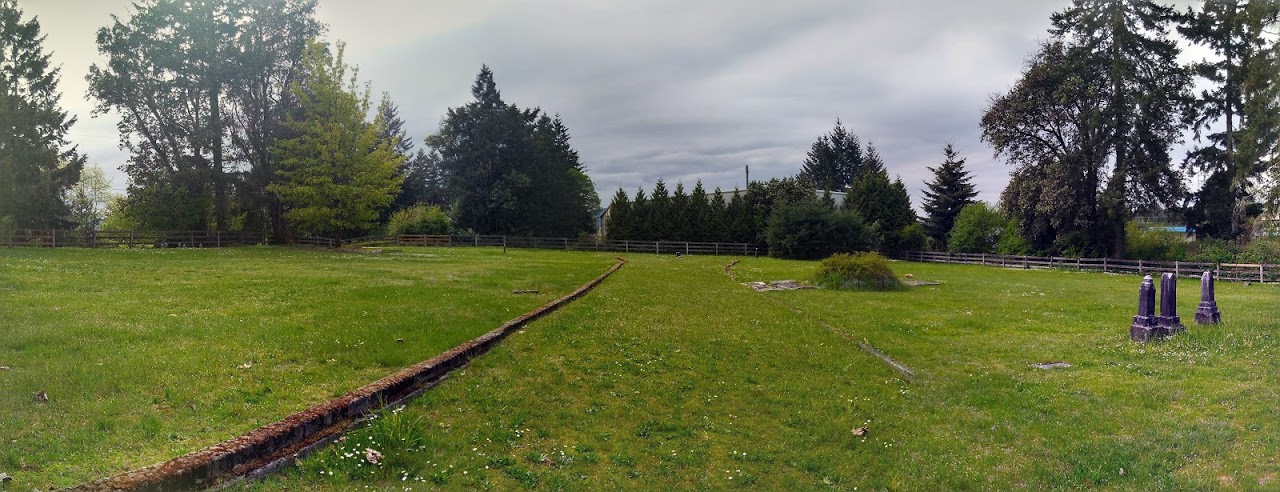
 Today part of the Regional District of Nanaimo’s Area C, the land around the former colliery is now primarily residential, with a definite rural feel. Although the coal days are long over, small reminders of Vancouver Island’s mining history can still be found in the street names in the area. The local improvement district, the Mountain Fire Protection District, has also chosen to maintain the East Wellington name for its fire department and new fire hall. As a side note, it was interesting to read the City of Nanaimo’s May 2018 report about the currently undeveloped park at 2191 East Wellington Road.

 The weekend was sunny and bright, and we decided to check out the
 The impressive concrete head frame and tipple at Morden is a precious tangible remnant of Vancouver Island’s coal mining past. The structure is one of only two of its type in North America (the other one is at the
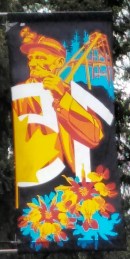 An interpretation of the iconic looming head frame was captured by local artist Patrick Belanger for Nanaimo’s Canada 150 celebration banners which were hung at major intersections around the city. The head frame and its adjacent tipple have also been replicated at the other end of the Modern Colliery Regional Trail at Cedar Road, with smaller wooden versions standing in tribute at the trail head.
 The part of the trail at Morden follows the old PCCM rail grade, and is an easy walk through the natural forest. I was somewhat surprised to come across a small piece of rail next to the path. It’s easy to walk right by without noticing, so keep your eyes peeled. My sons loved the two wooden bridges, and easy access to a small pond which was home to tadpoles in various stages of metamorphosis. The trail ends at a great view of the Nanaimo River, and we instantly wished we had brought along some drinks to enjoy at the cleverly placed bench overlooking the view.
 points on the path. In the trees not far away, the PCCM arch with a crumbling 1913 date is all that remains of what was a 60 foot smokestack of the boiler plant which powered the mining operation. I know a couple who had some of their wedding photos done there, and I have to say, I’m a little disappointed that I didn’t think of it for myself – especially because I grew up in South Wellington.
 I was pleased to see a small glimpse of myself captured in the school display. The display includes large format South Wellington Elementary all-school photos from the 1990s and 2000s, in some of which I found myself, my brother, and my friends. And at some point in the last two years an enterprising community member tracked down a South Wellington Elementary award plaque that happens to have my name on it for 1994/1995. My parents were so proud!

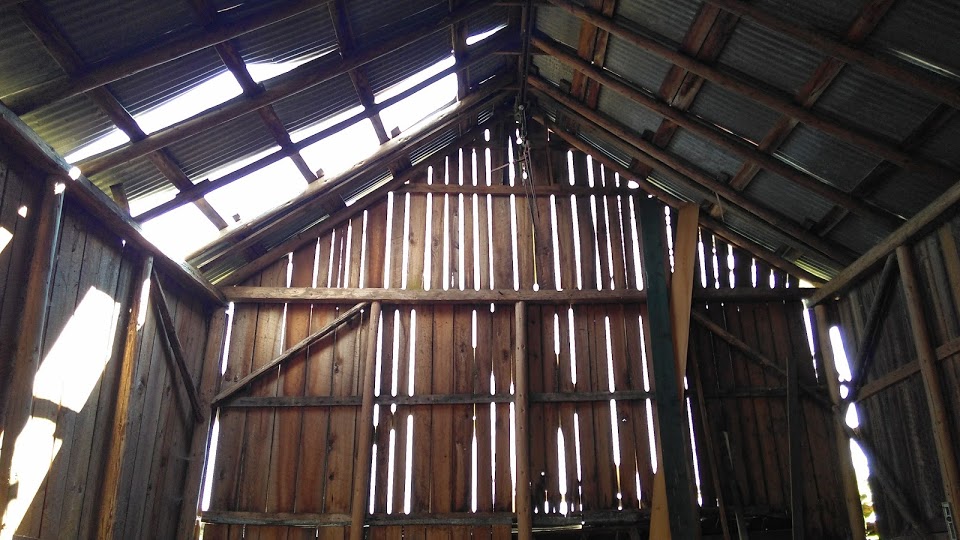 longer, no one knows. The light the comes in through the cracks makes me nervous to go in there, never mind the building’s distinctive lean to one side. My dad has plans to pull it down and reuse the barn board for projects, but it’s still standing for the moment.
 Back at the hall, I of course checked out the books for sale. I picked up a copy of Treasures of South Wellington, written and illustrated by former resident
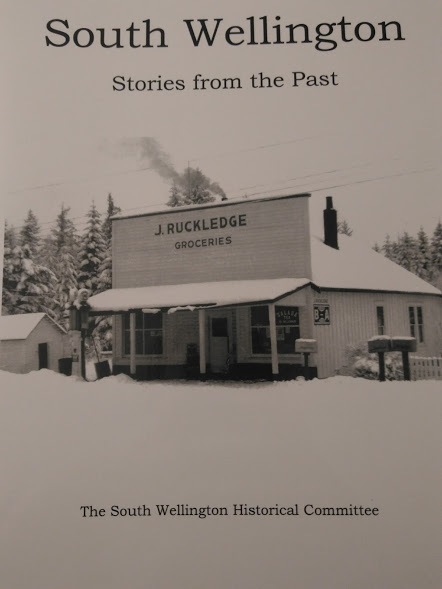 Also for sale was South Wellington: Stories From the Past, which was published by the South Wellington Historical Committee in 2010, compiling a series of interviews and submissions by past and present community members. This is a fantastic book, full of stories and personal anecdotes about early families in the area. If you have any interest in the community’s history, I would strongly encourage you to pick one up. They are usually available for sale at the Literacy Central Vancouver Island bookstore, and I’ve also seen them at Salamander Books in Ladysmith.