Britannia Mine Museum

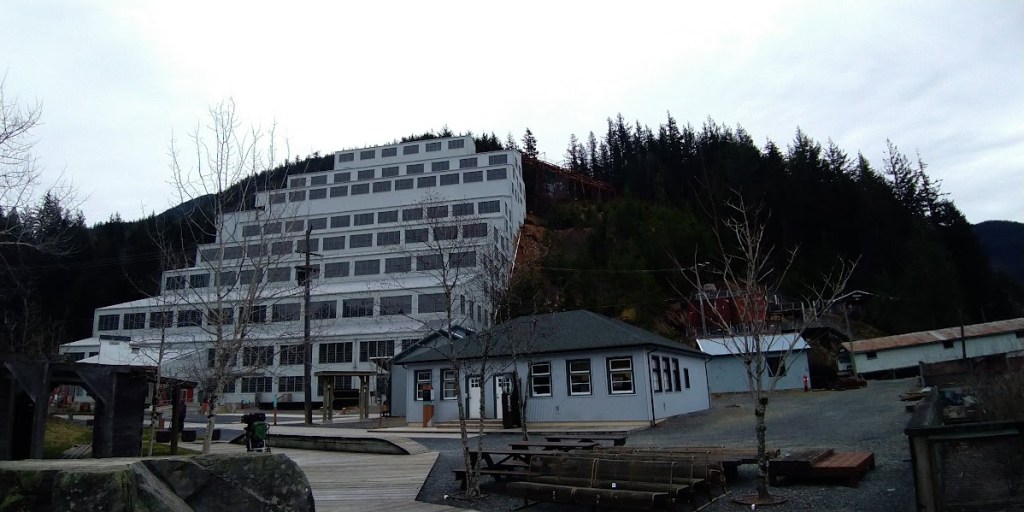
I love it when I can get my family to engage with B.C. history, and visiting the Britannia Mine Museum had been on my to-do list for a long time. A one-way vehicle and driver voucher that we’d received because of a cancelled BC Ferries sailing plus a Family Day Weekend promotion on admission at the museum meant that we had a great opportunity for an off-Island adventure. It did not disappoint!

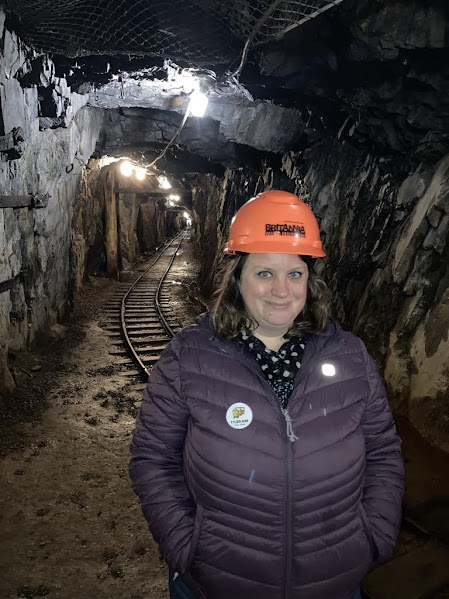
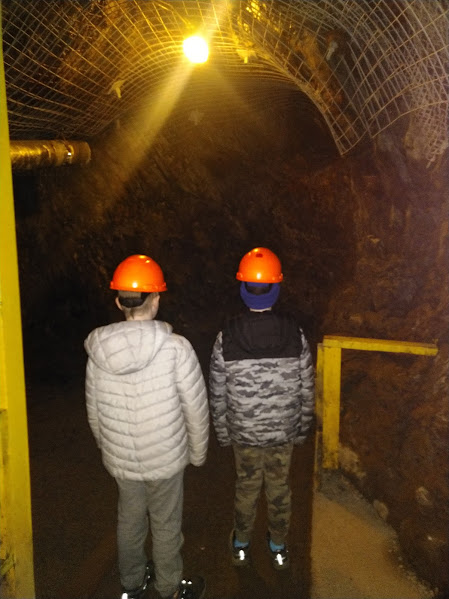
Taking the 8:25 a.m. ferry from Nanaimo, we arrived right on time for our 11 a.m. reservation at the museum. Soon after, we were heading underground for a guided tour of a haulage tunnel and then into the historic Mill No. 3 for the BOOM! show. We had a quick break for lunch and then spent some time exploring the other buildings and exhibits at our own pace. Overall, we spent three hours at the site and had plenty of time to get back to Horseshoe Bay for our 3:45 p.m. sailing back to the Island. We had a fun time checking out a neat place that we hadn’t been to before and learning about the mining operations there. I’d definitely recommend a visit for other families who are looking for an interesting day trip that contains a healthy dose of British Columbia history.

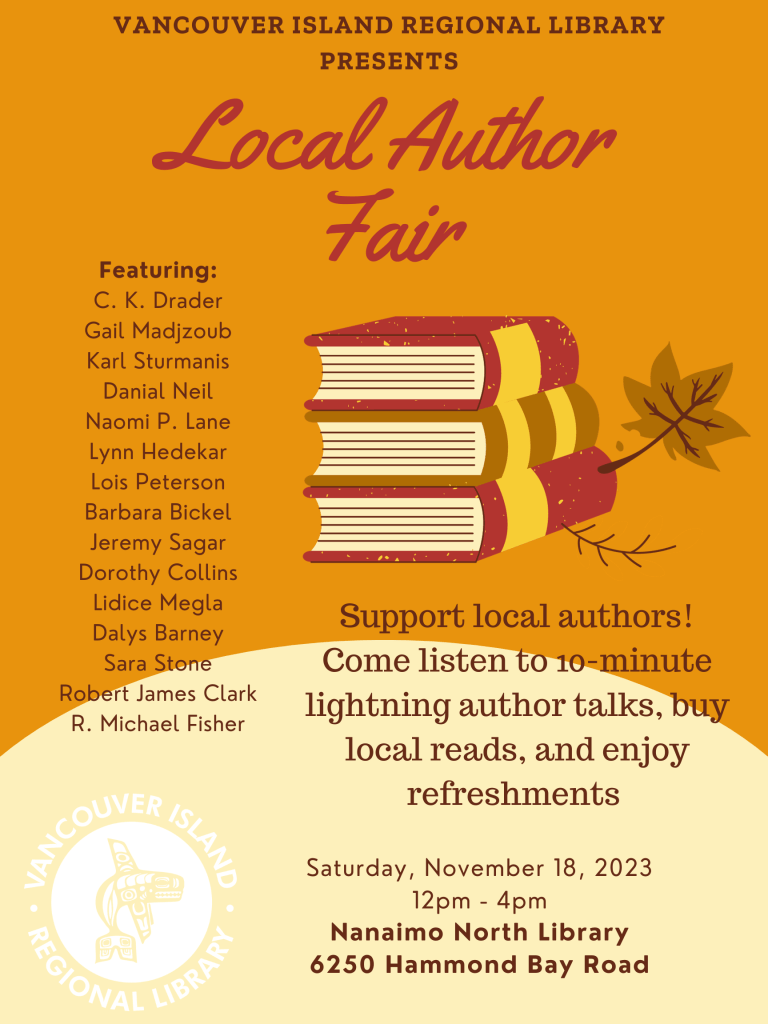
VIRL Local Author Fair – November 18, 2023

I’ll have copies of Message on a Bottle: Nanaimo’s Soda History for sale and I’ll be making a short presentation at the Vancouver Island Regional Library’s Local Author Fair on Saturday, November 18th from 12 – 4 p.m. at the Nanaimo North branch. Come say hi and tell me about your bottle collection!

Come see me a VIRL's local author fair on Saturday, November 18 from 12 - 4 p.m. at the Nanaimo North branch.

Presentation to the Nanaimo Family History Society – October 16, 2023

I will be sharing my Norwegian great-grandparents’ stories at a presentation to the Nanaimo Family History Society during their next meeting on Monday, October 16th at 7 p.m.

Ole and Konstanse (Fyhn) Olsen came to Canada separately from Norway prior to meeting and marrying in Bella Coola in 1914. My talk will cover the story of their individual emigrations from Norway in the early 1910s; the life they built together in Hagensborg in the Bella Coola Valley; and their move to Vancouver Island in 1935 after they experienced a terrible flood.

This will be a hybrid presentation, happening in person at the Beban Park Social Centre (Rooms 7/8) and through Zoom. Guests are welcome!

More info at https://nanaimofamilyhistory.ca/ or by emailing infonfhs[at]gmail[dot]com

Van Isle History Explorer Goes North: Bottles

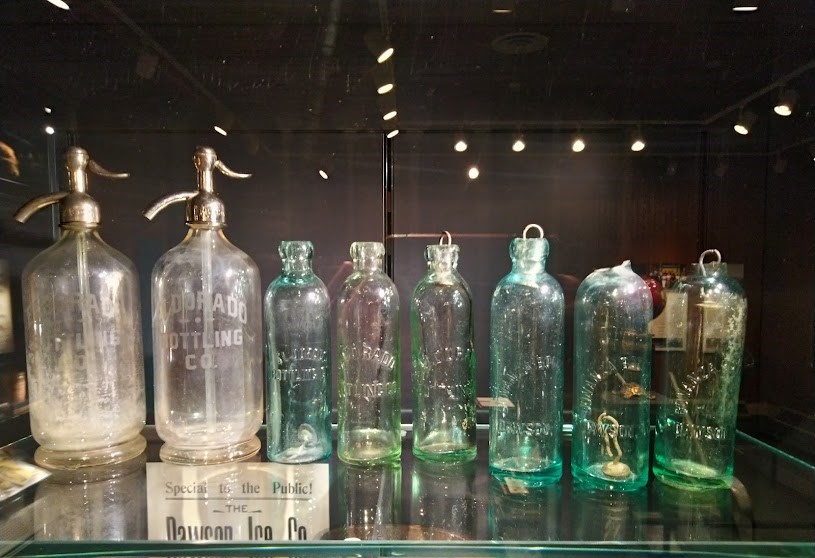
While on my trip north, and particularly while visiting the Dawson City Museum, I kept an eye out for soda bottles, and I was not disappointed. At the museum there was a nice collection of siphons and Hutchinson bottles from the Eldorado Bottling Company and Hutchinson bottles from the Bonanza Bottling Company.

Back home again, I did a little reading about these companies, which were both located in Dawson City. Eldorado operated from about 1899 to about 1916. Bonanza was an earlier company about which little is recorded. In an article written with Julia Pike, bottle collector Phil Culhane suggests that it’s possible that the proprietor of Bonanza Bottling sold his bottling equipment to the proprietor of Eldorado Bottling.1 Given what I know of the soda industry in Nanaimo during the same time period, where equipment had to be imported from afar, it seems like a very plausible story.

Soda bottles in the Dawson City Museum collection

The Bonanza bottles are potentially quite unique because the embossing on some bottles of this type reads “Bonanza Bottle Co. / Dawson City, N.W.T.” Prior to 1898 when the Yukon Territory Act was passed, Dawson City in its early days sometimes was referred to as being in the “Northwest Territories.” “‘The Northwest Territories’ was a blanket term used to cover all ‘other land’ in western and northern Canada for much of the 19th century.”2 Culhane and Pike suggest that the bottles marked with “N.W.T.” were likely used, or at least ordered, prior to 1898. I didn’t know all of this at the time of my visit, and I can’t tell from the angles of my photos if the museum’s bottles have “N.W.T.” embossed on them or not, but it’s certainly interesting.

Another bottle tucked in the corner of a display case was a bit of an unexpected find for this Vancouver Islander โ€“ a quart-sized embossed beer bottle from the Victoria Brewing Company.

Victoria Brewing Company beer bottle in Dawson City

With light exposure over time, the originally colourless glass has changed to a lovely amethyst colour. I will say that the bottle was in a display case with a bunch of purple artifacts, so the effect might have been exaggerated somewhat by the adjacent items, but it sure didn’t look clear to me. It’s my understanding that glass which contains manganese is known to irradiate and discolour into various shades of purple over time.

The Victoria Brewing Company was founded in 1859, but the museum’s bottle is not as old as that. In 2020, construction workers digging a trench at Royal Roads University in Colwood found a similar Victoria Brewing Company bottle (although it was amber coloured) and it was dated to around 1910 or 1911, likely from when the stables were constructed at Hatley Castle.3

Victoria Brewing Company bottles from my dad’s collection

I’d seen Victoria Brewing Company bottles with this same embossing before, my dad has two amber ones in his collection. But I’d never seen one that was that lovely amethyst colour. It was fun to see a Vancouver Island bottle so far from home and to think about how it might have made its way to the Klondike.

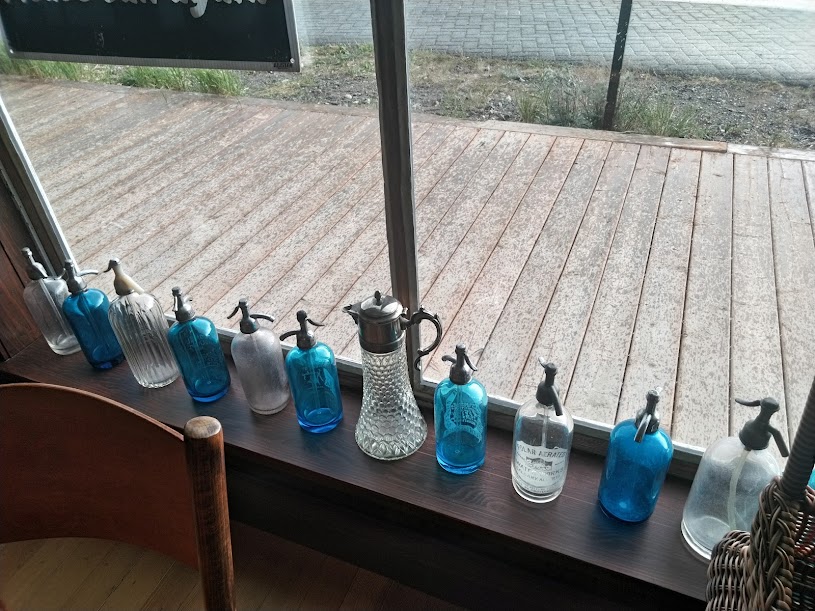
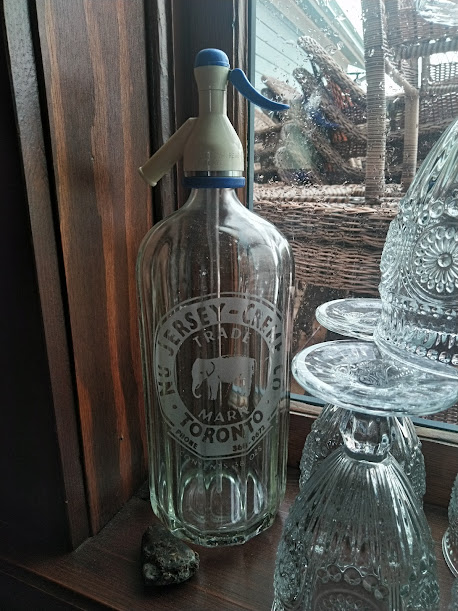
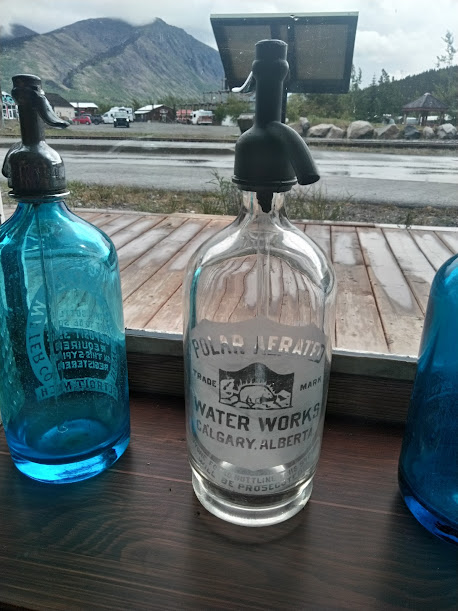
While in Carcross, a sudden rain storm saw us heading into the bar of the historic Caribou Hotel to get out of the downpour. Once there, I was happy to discover a nice collection of soda siphons. Around the room I counted over 25 different bottles, all intact and all with tops (although I wondered if some of the tops might not be original to the bottles). Most of them were were either clear or various shades of aqua or blue glass, but there were also a few nice green ones. Many of them seemed to be from New York state, particularly from Long Island. But there were also three Canadian bottles – one each from the Nu Jersey-Crรจme Company of Toronto; the Eskimo Bottle Works of Montreal; and the Polar Aerated Water Works of Calgary. It was hard to take nice pictures, as many of the bottles were set up on window ledges, but I thoroughly enjoyed looking at all the different labels, many of which had been acid etched. What a great collection!


Notes

  1. Phil Culhane and Julia Pike, “Yukon Gold!! The Bottles of Canada’s North,” Canadian Bottle and Stoneware Collector, 8, no. 4 (2004): 51.
  2. Culhane and Pike, “Yukon Gold!!,” 49.
  3. “A sip of history,” Royal Roads University, October 7, 2020, https://www.royalroads.ca/news/sip-history.

Van Isle History Explorer Goes North: Five Finger Rapids

The old barn at my parents’ property contained its fair share of treasures. One interesting item my dad found in there was a framed photograph of a steamship making its way through a narrow channel. There weren’t any accompanying details, and my dad was curious to know more, so he brought the picture to one of the Nanaimo Historical Society’sย Show & Share events. Members and guests bring artifacts, stories, and memorabilia to discuss, and he was wondering if anyone could identify either the ship or the location.

Parker Williams, a retired marine engineer, immediately suggested Five Finger Rapids on the Yukon River as a location where the photo might have been taken. Other members with connections to the west coast’s shipping industry strongly agreed. And they were absolutely correct!

Someone who worked for Yukon Tourism and Culture saw my online post asking about the photo and she also confirmed the location as Five Finger Rapids. She suggested reaching out to the Yukon Archives in Whitehorse for help with identifying the ship. I was in touch with Yukon historian Murray Lundberg, who identified the steamboat as the W.K. Merwin. Finally, the mystery was solved!

The W.K. Merwin was a sternwheeler than carried passengers and freight on the Yukon River during the Klondike Gold Rush. She was originally built in Seattle in 1883 and worked for a time on Puget Sound and on the Skagit River before being abandoned. To meet the demand of those rushing to the Klondike, she was put back into use. She was towed up the coast to the mouth of the Yukon River and she arrived in Dawson City in 1898. The W.K. Merwin was wrecked on the beach at Nome, Alaska in August 1900.

Once I knew more details about the photo, I was able to find it online. It’s a photograph taken by Eric A. Hegg from around 1898, and it is in the collection of the Museum of History & Industry in Seattle. A photographer based out of northwestern Washington, Hegg joined those rushing to the Klondike, setting up photography studios in Alaska, first in Dyea and later in Skagway. In the summer of 1898, Hegg headed to Dawson City, travelling north on the Yukon River in a boat with a homemade darkroom onboard. I wonder if the photo of the W.K. Merwin is from that trip.

On the drive from Whitehorse to Dawson City, the Five Finger Rapids Recreation Site was a must-see for me. We spent about an hour making our way down (and then slowly back up again!) the 219-step staircase that takes you to a viewing platform. Even though I didn’t have my dad’s picture with me, I wanted to see if I could get a modern-day photo of relatively the same spot.

According to the Government of Yukon’s website, the name “Five Finger Rapids” comes from the four islands that split the river into five channels. The rapids were a major obstacle for those heading to the Klondike, and only one of the channels was deep enough for sternwheelers like the W.K. Merwin. Sometimes ships even had to use a cable attached to the rocks to winch themselves upstream. Starting in 1900 and continuing until about 1927, blasting was done to widen the channel.

If you’re looking to visit a historical landscape as well as stretch your legs a little during the long drive between Whitehorse and Dawson City, I recommend you stop in at Five Finger Rapids.

Van Isle History Explorer Goes North: Whitehorse

I was happy to take a recent trip with a friend to Whitehorse, Dawson City, and Atlin, and over the coming weeks, I’ll be sharing a series of posts about my time there.

While I would have loved to make the drive, timewise, it made sense to fly to Whitehorse from Vancouver. We travelled with Air North, and I’d just like to say: “Wow!” Not only did they not charge me for a checked bag, but there was also a complimentary sandwich and a WARM COOKIE! Two thumbs up!

My first significant stop was the S.S. Klondike National Historic Site in Whitehorse.

The S.S. Klondike was launched in 1937 by the British Yukon Navigation Company, a subsidiary of the White Pass & Yukon Route Railway. She replaced an earlier sternwheeler of the same name which had been active from 1929 until her wreck in 1936.

The Klondike carried both passengers and freight, and primarily worked between Whitehorse and Dawson City. Notably, she was the last sternwheeler to be used commercially on the Yukon River. The Klondike was hauled ashore at Whitehorse in 1955 and donated to the Government of Canada in 1960. She was moved to her present site in 1966, designated as a National Historic Site in 1967, and opened to the public in 1981.

There are multiple guided tours offered by Parks Canada throughout the day, but access to the Klondike itself is currently somewhat restricted as she is undergoing restorations. One of just a few remaining steam-powered paddlewheelers of the hundreds that once worked on the Yukon River, the Klondike was definitely worth a visit.

My first day finished off with an evening visit to Miles Canyon. The beautiful turquoise waters of the Yukon River are a lot tamer now due to the nearby hydroelectric dam, but during the initial stages of the Klondike Gold Rush, many boats were wrecked in the canyon’s dangerous rapids.

We hiked for about an hour on parts of the extensive trail network in the area. The first point of interest was the Robert Lowe Bridge. Named after a long-serving politician, the 85-foot suspension bridge was built in 1922 as a tourist attraction. We also checked out the former site of Canyon City, a gold rush ghost town. Very little evidence is left of the townsite, which at one time apparently included a hotel, saloon, restaurant, store, stables, machine shop, and a North-West Mounted Police post, but there’s some interpretive signage and a restored tramway car. Prior to being a stopping place for those heading to the Klondike, the area was used for fish camps by local First Nations communities.

Even though we’d spent a good part of the day travelling to get there, I felt pretty happy about my initial day in the Canadian North.

Nanaimo Historical Society AGM

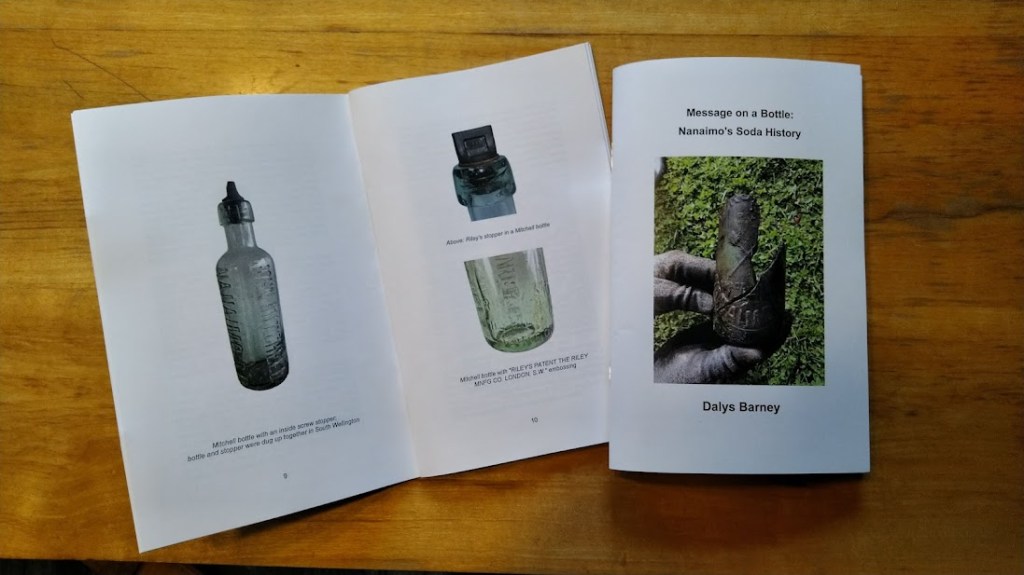
I’m excited to share that I will be giving a short presentation about my self-published booklet Message on a Bottle: Nanaimo’s Soda History at the Nanaimo Historical Society’sย upcoming AGM on Thursday, March 9th. Everyone welcome!

Message on a Bottle: Nanaimo’s Soda History

I’m excited to share that I’ve self-published a booklet, and that Message on a Bottle: Nanaimo’s Soda History by Dalys Barney is now for sale!

Available for $10 if I can connect with you locally near Nanaimo, or $12 if you need it mailed to you, the booklet will likely appeal to bottle collectors and to those interested in Vancouver Island history.

Starting as early as the 1870s, Nanaimo had entrepreneurs who were bottling and selling soda in the city. A small luxury that could be enjoyed by the young and old alike, bottled soda was especially welcomed at well-known Nanaimo summer events like the minersโ€™ picnic. While independent local soda businesses have faded away with time and industry consolidation, what weโ€™re left with today are the bottles, some of which feature iconic Nanaimo images like a crossed miner’s pick and shovel or the Bastion.

Not a pricing guide, but an attempt to tell the history of the city’s soda industry, the booklet focuses on single-serving glass soda bottles and Nanaimo manufacturers like William Rumming, John Mitchell, and Louis Lawrence.

Special thanks to the Nanaimo Historical Society and the Nanaimo Community Archives for helping to fund my printing costs.

South Wellington Mine

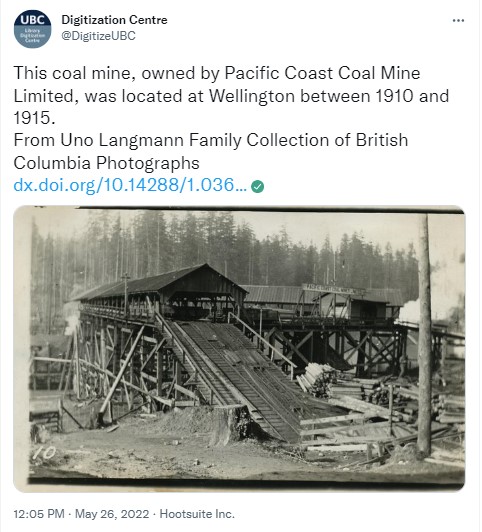
At the end of May 2022, the UBC Library Digitization Centre’s Twitter account featured a series of photos from their collection which depicted Nanaimo. I followed along closely because I love seeing old photos of Vancouver Island and of Nanaimo in particular. There was one photo from the Uno Langmann Family Collection of B.C. Photographs that immediately caught my interest because it was of above-ground coal mine structures.

The accompanying tweet read: “This coal mine, owned by Pacific Coast Coal Mine Limited, was located at Wellington between 1910 and 1915.” That made me pause, because having done some research on local coal mines, as well as being from the area, I know that Pacific Coast Coal Mines Ltd. was active in South Wellington, and not in Wellington, which was a Dunsmuir family interest.

I did some searching through the books I had at home and found a picture in South Wellington: Stories from the Past (a book complied by the South Wellington Historical Committee) of what I believe to be the same mine site from a different angle. This is a photo contributed by Jack Ruckledge and the mine is identified as the South Wellington Mine. That white “Pacific Coast Coal Mines Limited” sign on the roof of the building sure looks the same to me, but others can draw their own conclusions.

Above: South Wellington Mine photo found in South Wellington: Stories from the Past1
Photo used with permission of Helen Tilley

[Pacific Coast Coal Mine at Wellington, now Northern Nanaimo]
Photo UL_1088_0007 is from the Uno Langmann Family Collection of B.C. Photographs and is licensed under a
Creative Commons Attribution-NonCommercial-NoDerivatives 4.0 International License

The UBC image has a supplied title: “[Pacific Coast Coal Mine at Wellington, now Northern Nanaimo]” which I think is incorrect. When I looked more closely at the metadata for the item in UBC’s collection, it appears that the image was the front of a postcard. On the back of the postcard, which is unused, someone has written the following: “1918 Wrigley’s B.C. Directory lists: PACIFIC COAST COAL MINES Ltd. S. Wellington. This is 5 miles north of Nanaimo, on the E.N. Railway. Pop. 400. The mine itself is listed in the Nanaimo listings”.

[Pacific Coast Coal Mine at Wellington, now Northern Nanaimo]
Photo UL_1088_0007 is from the Uno Langmann Family Collection of B.C. Photographs and is licensed under a
Creative Commons Attribution-NonCommercial-NoDerivatives 4.0 International License

The person making this notation is correct is some respects, the Wrigley’s British Columbia Directory for 1918 does list Pacific Coast Coal Mines Ltd. in the Nanaimo section rather than in the tiny South Wellington section. Flipping through the alphabetical listings of the Nanaimo section, Pacific Coast Coal Mines Ltd. is in fact listed with “S Wellington” noted on page 303. The “5 miles north of Nanaimo” part of the notation on the postcard might have just been a small error made after looking at the brief description of South Wellington in the directory which reads: “a post office and coal mining town on the E. & N. Railway, 5 miles south of Nanaimo, and 68 north of Victoria, in Newcastle Provincial Electoral District. Population, 300. Local resources: Coal-mining.”2

The Nanaimo write up in the directory refers to South Wellington as being “but three miles from the city,” and I can assure you as someone who lived there for several decades, it’s south, not north of Nanaimo. Perhaps the person who wrote on the postcard was thinking of the earlier South Wellington, which was actually north of Nanaimo. In part two of my previous blog post series about the Wellingtons of Nanaimo, I look at this in more detail, but in the late 1870s, there was a small coal mining outfit which operated near the boundary of Robert Dunsmuir’s Wellington Colliery. This short-lived South Wellington Colliery was located just south of Dunsmuir’s Wellington, and the small settlement that developed around this mine was indeed “north of Nanaimo.” However, by 1879, the South Wellington Colliery was acquired by Robert Dunsmuir, and it was incorporated into the larger Wellington Colliery workings.

It’s important to note that coinciding with the discovery of coal at Extension, the mines at Wellington were winding down by the late 1890s, and that the last coal was removed from the No. 5 Wellington shaft in October 1900. In the tweet, UBC gives the photo’s date range as between 1910 and 1915, but that doesn’t actually fit with any Wellington mine timeline.

After Dunsmuir negotiated significant land and mineral rights as part of the E&N Railway deal, he began exploring coal prospects up and down the Island in the railway belt. In 1884, the Alexandra Colliery (also inconsistently remembered as the Alexander and Alexandria) was opened by Dunsmuir’s E&N Railway Company in the Cranberry District, south of Nanaimo. In addition to the mining rights obtained by Dunsmuir as part of the E&N deal, adjacent mineral rights were purchased from James Beck, a significant landowner in the area.

As typical with coal mines at the time, a small settlement grew up around the mine site. The townsite initially called itself Alexandra, but an 1899 application to the post office proved a very similar name was already in use in B.C. Fort Alexandria, north of Williams Lake on the Fraser River, had been opened by the North West Company in 1821.

The original small north-of-Nanaimo South Wellington townsite had faded away, so that town name was available. The Alexandra townsite in the Cranberry District was renamed South Wellington when the post office opened there on August 1, 1899. The possible suggestion of a connection between the new Alexandra Mine prospect with the well-known Wellington Colliery reputation was a bit of a stretch. Although the Alexandra Mine was certainly a Dunsmuir operation, it worked the Douglas Seam rather than the Wellington Seam which was known for its high-quality coal.

The Alexandra Mine didn’t prove to be a winner in the area, but in 1907, John Arbuthnot, the former mayor of Winnipeg, formed South Wellington Coal Mines Limited after securing mineral rights from early South Wellington settlers. Under the 1904 Vancouver Island Settlers’ Rights Act, local families that could prove that they had been on their railway belt properties prior to 1884 were able to apply to retain mineral rights rather than have them surrendered to Dunsmuir as part of the E&N Land Grant. Arbuthnot’s company arranged a 3-year mining lease on the 160-acre Fiddick property as well as a 20-year mining lease on the adjoining 320-acre Richardson property. In 1909, Arbuthnot reorganized his company as Pacific Coast Coal Mines Ltd. with the intention of further developing coal mines in the South Wellington area as well as exploring other prospects further up the Island near Suquash.

Not far away from the South Wellington townsite, the PCCM operated the Fiddick and Richardson slopes together as the South Wellington Mine until 1917. Boat Harbour opened as the companyโ€™s shipping point in 1909, with a seven-mile company rail line running from there to South Wellington. Parts of today’s Morden Colliery Regional Trail, which has a section that starts at the Morden Colliery Provincial Park and ends at the Nanaimo River, make use of some of the old PCCM rail grade. You can even see a small piece of rail next to the path in one section.

UBC seems to have overlooked the “S.” on the back of the postcard when creating a title for the image on the front. I did reply to their tweet with my suggestion that the caption was incorrect, but I’m not sure my saying so will be enough to see a change to the image’s title. But you can’t really fault someone for trying to get their hometown community its fair share of the limelight.

Pacific Coast Coal Mines Ltd. is perhaps better known for its other mine at Morden Colliery. The two shafts at Morden were known as No. 3 and 4, as No. 1 and 2 were the Fiddick and Richardson slopes of the South Wellington Mine. Those already familiar with the PCCM’s South Wellington Mine may recall that in 1915, it was the site of a terrible disaster resulting from a map scale reading error. Rick Morgan of the Ladysmith and District Historical Society has written an extensive blog post about this tragedy in which 19 miners died. Mining at the PCCM’s South Wellington Mine continued for only two more years after the accident, and in 1917, the mine was closed, and the company focused its efforts on Morden.

Despite Morden’s modern equipment and the companyโ€™s hopes and investments, it never proved to be a very successful mine. In 1922, the mine was closed and flooded, and the PCCM went into voluntary liquidation. In 1930, Morden was briefly reopened by the Canadian Coal and Iron Company, but this also proved to be unsuccessful, closing later that year.

Both the Richardson and Fiddick slopes were reopened in the late 1920s and were worked on and off into the 1940s as small operations independently run by the Richardson and Fiddick families. The intention in both mines was to focus on recovering pillars left by the PCCM’s earlier workings. In 1928, 72 tons of coal were removed from the Richardson Mine, part of which was also known as the Ida Clara Colliery, and 1,805 tons were taken out of the Fiddick. In 1979, Dolly Gregory was interviewed for the Coal Tyee History Project and she shared stories and memories about mining with her husband, Bill Richardson, in the 1930s. Historically, coal mining has been an industry almost entirely dominated by men, so this interview with the only known female coal miner in the area is a real treat.

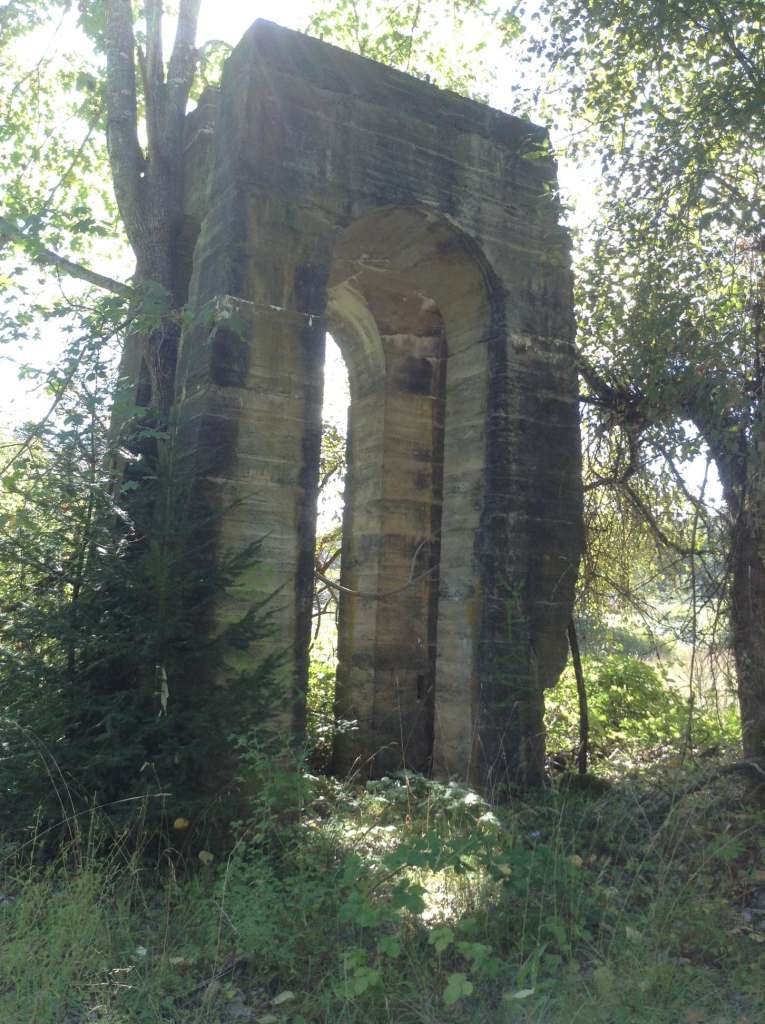
The only physical remnant of the South Wellington Mine that is still around today is a concrete structure that I’ve been told was likely a support for the tipple. A shorter but similar, more accessible, PCCM arch can be found within the Morden Colliery Provincial Park.

Concrete arch at the former South Wellington Mine site
photo courtesy of Maechlin Johnson

I’ve always been interested in the South Wellington Mine story because Robert Miller, an earlier owner of the property where my parents live and the builder of their barn, drowned in the 1915 accident. The Miller barn stood as a significant figure in the valley landscape in South Wellington for over 100 years, but in 2019, the old girl came down.

Barn built by Robert Miller on my parents’ property in South Wellington.
The section on the right was likely a later addition to the original loose hay barn.

While cleaning up the barn in preparation for the demolition, my dad found a miner’s tag hanging on a nail in the barn. Even though my family had lived on the property for over 30 years, we hadn’t discovered the tag. It was only when the barn’s time was coming to an end that the round, toonie-sized marker was discovered in plain sight. Miners used the tags for a variety of reasons, including indicating one’s presence underground, checking out lamps and tools, and marking cars filled with coal. They are quite collectable and my dad had been looking for one for years. While we don’t know for sure, we like to think that it was Robert Miller who hung the tag in the barn and that it may in fact be a memento from the South Wellington Mine.

Miner’s tag found in my parent’s barn

*Thank you very much to Helen Tilley for sharing her extensive research confirming that Alexandra (not Alexandria or Alexander) is the original name for the Dunsmuir mine which opened south of Nanaimo in 1884. The community that grew up around the mine (known today as South Wellington) also shared this name for a time, and I have updated this post so I don’t further contribute to the name being misremembered as Alexandria or Alexander.


Notes

  1. Tilley, Helen, “The Fiddick and Richardson Slopes of the South Wellington Mine,” in South Wellington: Stories From the Past (South Wellington, BC: South Wellington Historical Committee, 2016), 6.
  2. Wrigley’s British Columbia Directory: 1918 (Vancouver: Wrigley Directories, 1918), 424, https://bccd.vpl.ca/index.php/browse/title/1918/Wrigley%27s_British_Columbia_Directory.

The Olsens in Bella Coola

Iโ€™m happy to be writing a series of blog posts about my great-grandparents,ย Ole Olsenย and Konstanse Fyhn. This third installment is the story of the Olsens’ time in the Bella Coola Valley after their marriage in December of 1914 until they left the valley in early 1935.

While many of the original Norwegian settlers in the Bella Coola Valley had dreams of making a living off the land and selling produce to support themselves, this proved to be challenging. Diana French, an author based in the Cariboo Chilcotin region, reflects on how the original colonists must have wondered at their choice: “The valley was dreary. The mountains loomed over the newcomers, critical of every move. There were no open meadows in the valley. Every inch of land was buried under thick tangles of brambles and bush, windfalls and enormous trees.”1

While the land they had heard promising tales of did prove to have rich alluvial soil, great for growing potatoes and fruit trees, massive trees covered everything in sight. The river, with its frequently shifting flood plain, was also a challenge to farmers living on its banks. But probably the biggest impediment to the colonists making a living from the fruits of their labour was the lack of access to the Bella Coola Valley, and “by 1915 everyone realized that the valley’s remote location made full-scale farming a chancy business.”2

To earn a living, many of the men of the Norwegian community, my great-grandfather Ole included, worked as commercial fishermen, spending long periods of time away from home. Ole fished salmon in Rivers Inlet from spring to autumn, and sometimes went out again in November, when he headed to the west coast of Vancouver Island to fish the runs there. With a can of salmon considered the ideal army ration, B.C. salmon was in demand during World War I.3 Fishermen like Ole would have likely found plenty of demand for their catch. But other times were tougher. “In the very early twenties the fishing was not rewarding,”4 local historian Cliff Kopas records in his history of Bella Coola. Families likely had to subsist on what their garden could provide them. “In a poor fishing year, the women probably made more of what they realized in the garden than the men did.”5

bella colla, mom,arnold , einar,dad, johnnyThe Olsens circa 1923 – Konstanse, Arnold, Einar, Ole, and Johnny

With the men away for long periods of time fishing, the women were frequently left to take on most of the responsibilities at home, including raising the children and tending the farm. With young ones to care for, animals to mind, household tasks to be done, bread to bake, and gardens to plant, weed, and harvest, women like my great-grandmother Konstanse would have had more than enough chores to keep themselves busy. Perhaps this helped to distract Konstanse from her loneliness, for “the lot of a fisherman’s wife was a solitary one in rural British Columbia.”6

Ole was joined fishing by his sons as they aged, with his oldest son Johnny eventually running a boat of his own. In what seems to be a very popular generic “Norwegian fisherman in Bella Coola” image, a young Johnny Olsen is captured in a photo taken by Cliff Kopas, who in addition to being a local historian was also an avid photographer. The image turned up in multiple books that I read during my research. My grandmother always claimed that her brother was in a “famous” photo, but the young fisherman I encountered again and again was always unidentified. Finally, in a book edited by Kopas’ son Leslie, I found a proper caption for the photo. It was Johnny after all, my grandmother’s eldest brother. What a nice surprise!

Johnny also makes an appearance as an eager but green cowboy in Isabel Edwards’ book Ruffles on My Longjohns, which chronicles the Edwards family’s experiences homesteading in the Bella Coola Valley. “The saddle was for a young Hagensborg chap named Johnnie Olson [sic] whom Earle had met out on the fishing grounds. Johnnie longed to be a cowboy. His only dream was to ‘ride the hurricane deck of a cayuse,’ but he had no saddle, nor a horse to put one on.”7 After his pack horses desert him and he has to spend a night out alone in the cold with no axe or matches, Edwards says Johnny changed his mind about his dream and “with an air of finality the words burst from him, ‘But to hell with horses!'”8 So it was back to fishing for Johnny Olsen, and in a cruel twist of fate, Bella Coola’s iconic fisherman died doing what he knew best. Having never learned to swim, Johnny presumably drowned in 1969 while fishing off the coast of Prince Rupert. His body was never recovered.

bella colla, dad, mom, eva, johnny,arnold,olive,henry,herb,eThe Olsens circa 1930 – Back row: Ole, Konstanse, Eva, Johnny, and Arnold;
Front row: Olive, Henry, Herb, and Einar

In October of 1934, after a heavy snowfall followed by an unusual warm spell and multiple days of rain, the Bella Coola River rose swiftly and flooded the Olsens’ property near Hagensborg. Ole and Johnny were away fishing at the time, so Konstanse was the only parent at home with the eight younger children as the river rose closer and closer to the house. Baby Robert was just a few weeks old at the time. The family sheltered in the house, feeling especially terrified after “away out in the night there came the most awful shock. As though the house itself were falling to pieces. … Arnold instantly interpreted: ‘The Branch bridge.'”9 The Olsens’ farm was located on an island which was connected to surrounding land by two bridges. The children were upset; they were out of drinking water, and the river continued to rise. A second roar indicated the main bridge also being washed away.

Great tree trunks from a dislodged log jam struck “the house so hard the whole place shook and faltered as though the boards were being warped crazily and all the nails pulled out at once. It struck them dumb.”10 With trees racing through the flood waters like battering rams, the river was no place for the family’s small rowboat, and they were trapped on their island. The Olsens prayed.

And their prayers were answered. Together with a crew of Nuxalk paddlers, the local doctor from the Mission Hospital, Dr. Herman McLean, and the provincial police constable, whom I believe was Jack Condon, rescued the Olsens in two great spoon canoes. My grandmother’s brother Einar remembered one of the Nuxalk rescuers as being Clayton Mack, later known as “The Bella Coola Man.” While I didn’t find any reference to Mack rescuing a flooded-out white family in 1934 in either of his biographies, it’s the kind of tale that would fit right in with Mack’s other adventures. Mack would have been approximately 24 years old at the time of the flood. A canoe rescue might have been not only enticing for its sense of adventure, but also quite doable given his familiarity with the area and in handling canoes. He certainly rescued his fair share of others from all sorts of wilderness scrapes during his many years as a grizzly bear guide in the Chilcotin. So, while I may never confirm that Clayton Mack was among the Olsens’ rescuers, it sure makes a good Bella Coola tale.

“I remember being in that flood, raging water everywhere, tree trunks, chickens, and planks swirling past us,” my grandmother Eva recalled.11ย The family was loaded into the two great canoes, and the children were told to “Sit still!” with “enough authority in it to silence nearly forever all the rambunctious, disorderly kids in the whole world.”12ย Einar remembered being scared and excited, and when interviewed about the flood he confided: “I almost wet my pants!”13

But the Olsens weren’t in the clear yet. When the canoes were beached on a sandbar, the family had to unload. The shifting sands caused Einar to lose his footing and he disappeared into the river with his baby sister Eleanor in his arms. A Nuxalk paddler grabbed Einar by the hair and pulled and the two Olsens were rescued a second time, “the infant still clasped in [Einar’s] unyielding grasp.”14ย What a terrifying ordeal. It’s no wonder that, as my father’s cousin aptly wrote in a newspaper article about the Olsen family, “this harrowing story continues to be one that is retold in our family and handed down through the generations.”15

The 1934 flood was the largest in the valley in 60 years.16ย With 11 acres of their land swept away, and a house that would never be the same, the Olsens’ farm was a grim picture. My grandmother’s brother Einar reflected in a 1998 interview: “We didn’t recognize the place. … There had been two benches of land and now it was all changed. There was six feet of river silt where there had been green grass and water had ruined everything in the house. All the years of hard work were destroyed.”17

It was time for the Olsens to leave the Bella Coola Valley.


Notes

  1. Hank Olsen, Bella Coola Lady and Thatโ€™s No Maybeย (Victoria, BC: Trafford Publishing, 2003), 28.
  2. Paula Wild,ย One River, Two Cultures: A History of the Bella Coola Valleyย (Madeira Park, BC: Harbour Publishing, 2004), 125.
  3. Mark Forsythe & Greg Dickson, “The Gift of Salmon,” inย From the West Coast to the Western Front: British Columbians and the Great Warย (Madeira Park: Harbour Publishing, 2014), 68.
  4. Cliff Kopas,ย Bella Coolaย (Vancouver: Mitchell Press, 1970), 266.
  5. Gordon Fish,ย Dreams of Freedom: Bella Coola, Cape Scott, Sointula (Victoria: Provincial Archives of British Columbia, 1982), 42.
  6. Olsen,ย Bella Coola Lady and Thatโ€™s No Maybe, 33.
  7. Isabel Edwards,ย Ruffles on my Longjohns (North Vancouver: Hancock House, 1980), 241.
  8. Edwards,ย Ruffles on my Longjohns, 242.
  9. Olsen,ย Bella Coola Lady and Thatโ€™s No Maybe, 128.
  10. Olsen,ย Bella Coola Lady and Thatโ€™s No Maybe, 130.
  11. Eva Johnson, diary entry.
  12. Olsen,ย Bella Coola Lady and Thatโ€™s No Maybe, 132.
  13. Wild,ย One River, Two Cultures, 164.
  14. Olsen,ย Bella Coola Lady and Thatโ€™s No Maybe, 132.
  15. Marcy (Olsen) Green, “An Immigrant’s Journey: The Olsen Family,”ย The Vancouver Sun,ย April 29, 2008, B3.<
  16. D. Septer,ย Flooding and Landslide Events in Northern British Columbia, 1820-2006,ย ([Victoria, BC:] Ministry of Environment, [2007]), 28, http://www.env.gov.bc.ca/wsd/public_safety/flood/pdfs_word/floods_landslides_north.pdf.
  17. Wild,ย One River, Two Cultures, 164.