This article was originally published in the Winter 2021 newsletter of the Nanaimo Historical Society. Thank you to the NHS board for giving me permission to share it here. Photography by Liz Laidlaw, VIU Library.
Did you know that the Library at Vancouver Island University has a digital archive of audio recordings of past Nanaimo Historical Society presentations dating back to 1962? You can find it online at: https://viurrspace.ca/handle/10613/14118.
In 2001, Shirley Bateman and other members of the NHS reached out to the Library at what was then Malaspina University-College. The Society was inquiring about the possibility of copying a set of cassette tapes containing recordings of NHS presentations from 1962 to 1973. Some of these cassettes had likely been created by a Malaspina student in 1974 by copying William Barraclough’s original reel-to-reel recordings, which were thought to be among the first documented recordings of their kind made in the province. The cassette tapes were deteriorating and the Society was hoping the Library could assist with making compact disc versions. In addition to being deposited at the Nanaimo Community Archives, a set of the recordings was kept in the Special Collections vault at VIU, and when technology allowed the Library to do so, digital mp3 files were created. These audio files were put online in VIUSpace, VIU’s digital library, in 2010 and form the first part of the Nanaimo History Project, which can be found here: https://viurrspace.ca/handle/10613/14119.
In 2019, a Memorandum of Agreement was signed between the NHS and VIU Library allowing for a second set of NHS cassette tapes to be temporarily transferred to the Library with the intention that they would also be digitized and made available online. The NHS was again concerned about the lifespan and accessibility of an aging cassette tape collection, while VIU Library perceived value in facilitating preservation and access to local- and BC-focused content to support new lines of inquiry and study for students, researchers, and members of the community. Working within the context of its strategic plan, which includes decolonization and community engagement objectives, the Library took steps to make its services and supports known and available to the Nanaimo Historical Society.
This second set of recordings, consisting of four boxes of over 100 cassette tapes mostly created by Pamela Mar and including NHS presentations from 1976 to 2011, will form the second part of the Nanaimo History Project, which can be found here: https://viurrspace.ca/handle/10613/14120. Digitization work is currently ongoing for this second set of tapes – over 125 audio files are now available with more being added on a regular basis.
With a keen interest in both local history and digitization work, the project has been a great fit for Dalys Barney, who is not only an NHS member, but also part of the VIU Library team that is doing this work. During the early stages of the pandemic, Dalys and her colleague Sarah Ogden were both working from home and had an opportunity to complete some transcripts for this collection. Now that Sarah has returned to working on campus (Dalys is still working remotely), the focus has shifted back to getting more of the tapes digitized and uploaded to VIUSpace. Expanded summaries, subject headings, and more transcripts will eventually follow as time and resources allow.
Consisting of family histories, recollections about school days, book talks by local authors, and presentations about a variety of Nanaimo and Vancouver Island events, businesses, buildings, people, and organizations, the collection is truly a treasure trove of material for anyone interested in the area’s human, industrial, built, or natural history. Like everything in VIUSpace, the Nanaimo History Project is open access, meaning anyone can listen to the recordings – you don’t need to be a VIU student or staff member.
NHS members may also be interested in other VIUSpace collections, such as the Coal Tyee History Project, which contains a series of audio interviews with Vancouver Island coal miners and their families conducted by the Coal Tyee History Society in the 1970s and ’80s. Digital audio files and transcripts can be found at: https://viurrspace.ca/handle/10613/25. If you’re interested in historical Vancouver Island newspapers, digitized versions of the Nanaimo Free Press (1874-1928) and the Cowichan Leader (1905-1928) can also be found in VIUSpace and are accessible here: https://viurrspace.ca/handle/10613/6678.
This book review was originally published in the Fall 2020 issue (53.3) of British Columbia History, a quarterly magazine published by the British Columbia Historical Federation. I’d like to thank the magazine’s editors for giving me permission to share it here.
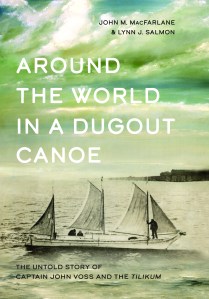
With their new book, Around the World in a Dugout Canoe: The Untold Story of Captain John Voss and the Tilikum, maritime historians John M. MacFarlane and Lynn J. Salmon have attempted to set the record straight about one of the west coast’s most misrepresented seamen, Captain John Voss, whose reputation as a master mariner has been questioned for over a century.
Setting sail from Victoria in 1901, Voss spent the next three plus years and 40,000 miles completing an epic journey around the world in the Tilikum, a converted Nuu-chah-nulth cedar canoe. Covering the Tilikum’s voyage from Victoria to the Pacific Islands, to Australia, New Zealand, South Africa, Brazil, and finally to England, this book is an opportunity to step on board with Voss and his revolving door of first mates as they adventure around the world.
While Voss and the Tilikum were greatly admired by contemporary followers, the damaging allegation that Voss murdered the second of his mates in a drunken fight has been a shadow on his legacy that even time has had trouble erasing.
This book is an effort by MacFarlane and Salmon to counter the existing body of inaccurate and distorted information about Voss and his voyage, and to present a more complete account of what really happened. The authors drew from years of careful and critical research, during which they consulted newspaper accounts from around the world, as well as archival material, photographs, and testimonies to piece together as much information as possible about the Tilikum’s journey. Their research also included close readings of both John Voss’ and Norman Luxton’s (Voss’ initial first mate) books about the voyage. Details from these contradictory accounts are carefully considered, compared, and questioned by MacFarlane and Salmon.
Around the World in a Dugout Canoe sails smoothly from opening background chapters about Voss and Luxton to ones on the Tilikum’s preparation, departure, and major stops. A significant number of pictures from a variety of sources thoughtfully highlight the text, and the book is written in such a way that even landlubbers are able to wade through the nautical jargon – especially with the help of a glossary found in the back of the book.
MacFarlane and Salmon have done an excellent job of taking readers along on the Tilikum as Voss and his mates face multiple challenges. We experience the panic of getting down to the last few gallons of water, the hunger felt by Voss and his crewman as the food supplies run low, the endless monotony of the open sea, and the unpredictable and extreme weather conditions. The fragility of a journey that could have come to a tragic end at any moment is conveyed, while the constraints of the extremely limited space and the burden of constant companionship are easily understood. It’s no wonder that while Voss was dedicated to his goal of circumnavigation, he spent significant amounts of time onshore throughout the journey.
Not only was it fascinating to read about the celebrity status Voss and the Tilikum achieved at ports of call around the world – drawing in huge crowds to see their arrival, hear Voss’ lectures, and watch their departure – but it was also interesting to learn more about how Voss was a forefather of challenge-based long-distance recreational sailing. Throughout the years, journeys like the Tilikum’s have inspired countless individuals to attempt record setting voyages.
In one of the concluding chapters of the book, we leave Voss behind in England, and we follow the Tilikum herself through her descent into disrepair and her eventual repatriation to Victoria. After being carefully restored, the Tilikum was showcased proudly in her home province – first in Thunderbird Park starting in 1941, and then from 1965 to 2015 in the main gallery of the Maritime Museum of British Columbia.
While the Tilikum is currently in storage at the Ogden Point passenger terminal in Victoria, the media is reporting that the Maritime Museum of British Columbia has a plan to relocate to a new home in Langford. One hopes that the new location will mean that the Tilikum, an important piece of the province’s nautical history, will once again be accessible for the general public to enjoy in all her glory.
In the meantime, anyone interested in learning more about the Tilikum and Captain Voss will certainly enjoy reading this book.
What do stumping powder, the SS Oscar, and the mostly empty cans of paint in my basement all have in common? They’re all connected to Canadian Industries Limited, or CIL, a brand name that many Canadians will recognize from their paint cans, but one that people from Nanaimo might also associate with the neighbourhood of Cilaire. After encountering a post on the Library and Archives Canada Discover blog about the company history of the CIL brand, I thought I would explore the (unmentioned) tie of CIL to Nanaimo a little further.
By the late 1880s, the Nanaimo area had a busy coal mining industry. The Vancouver Coal Mining and Land Company’s No. 1 Esplanade Mine downtown was in full operation and the Dunsmuir mines in nearby Wellington were also very active. Wanting to take advantage of the demand for blasting powder, the Hamilton Powder Company, which had opened an office in Victoria in 1884, began to explore the idea of establishing a black powder works in the Nanaimo area. “Because of the extensive mining of coal in Nanaimo and other parts of the island the Hamilton Powder Works were encouraged to come and set up a plant to produce badly needed blasting powder. Cost of shipping the product from England was high and the product was often ruined with saturation of seawater.”1 In 1890, the Hamilton Powder Company built and opened a plant about four miles out of Nanaimo in Northfield on a 156-acre piece of land. “At Northfield, ten acres of land was cleared on which to build storehouses, a gristmill, boiler and power plant, all out of brick. The roofs were built in such a way as to send them skyward in the event of an explosion. The plant was built and operational by the autumn of 1890.”2
At the time, the powder works was likely welcomed by the community as it provided local jobs as well as savings for those using explosives. As Vancouver Island historian T.W. Paterson notes, “Total production cost of a keg of powder was $1 which wholesaled at $1.75 and was retailed to miners at $2-$2.25. … This was a substantial saving over the $4 previously charged by the companies.”3
In 1892, wanting to expand into dynamite manufacturing, the Hamilton Powder Company opened a second plant in the area on a 100-acre property at Departure Bay. Here they would manufacture their own nitroglycerine, the explosive and volatile chemical required to make dynamite. Dangerous supplies and cargo were carried by wagon between the two locations along the Black Powder Road.
Nanaimo historian Lynne Bowen captures the risk of transporting such dangerous cargo: “Extra heavy springs and four inches of wood shavings on the wagon floor gave the six or eight glass containers a small extra measure of cushioning. A lone man drove, his back to the ominous cargo. The wagon driver knew the danger involved in transporting the cargo up the muddy and rutted Black Powder Road which led to the Northfield Powder Works. He had done it many times and he always insisted on doing it alone. His luck had always held until one day in 1896. One morning it blew. They don’t know exactly what happened, maybe two of those big demijohns started to rub together. But the horse and the wagon and everything went and him right in the middle of it. He was blown to bits; the horse was blown to bits. They never did find him or the wagon. Made a hole in the road you could sink a house into.”4
As well as black powder and dynamite, the Hamilton Powder Company also locally manufactured a somewhat less dangerous product called Dualin stumping powder. Dualin was an explosive made by mixing nitroglycerin with an inert substance like sawdust or wood pulp. The Hamilton Powder Company’s explosives were used on Vancouver Island by coal miners, farmers, and local contractors, and the company’s products were also shipped to destinations elsewhere from the company’s wharf at Departure Bay.
An article in TheDaily Colonist from 1920 reflected on the importance of explosives at the time: “The miner does not force a foot of his subterranean advance under the eternal hills without its help. The gold, copper, iron and coal that warm and energize and carry and pay the way of the world have all been driven, as it were, to the surface of the earth by the force of an explosion. The explosive has its work to do in the clearing of forests, the planting of trees, the cutting of canals, the building of railroads, the quarrying of building stone, the irrigation of dry lands. The explosive has become the veritable hammer of the industrial Thor. It is a giant pick, a swifter plough, a subtle and mighty tool in the cunning hands of men.”5
As detailed in the Library and Archives Canada blog post, the Hamilton Powder Company merged with six other companies to form a new company, Canadian Explosives Limited (CXL) in 1910. At around this same time, capacity of the Nanaimo operations was becoming strained by BC’s railway and mining booms. The Nanaimo plants were connected with the company’s offices in Victoria and Vancouver. Additionally, there was an office in Nelson which supported the needs of the growing mining industry in the Kootenays.6 There was plenty of demand for explosives, but any expansion of the Nanaimo plants was restricted by regulations which dictated that there must be a certain amount of distance (1.5 miles) between an explosives plant and non-company owned buildings.7
Despite a bylaw passed by Nanaimo city council in 1898 which stipulated that: “No more than fifty pounds shall be carried or conveyed on any vehicle whatever within or through the streets of the City and that no more than fifty pounds of powder should be kept in any store, dwelling, or building within City limits,”8 Nanaimoites must have questioned the safety of having CXL operations nearby. A series of deadly accidents occurred throughout the years, including an explosion at the Departure Bay plant in January of 1903 which “launched a piece of railway track 80 metres through the air with such force that it wrapped itself around a tree.”9 The community’s fears were additionally fueled by the terrific explosion of the SS Oscar in 1913.
On the afternoon of January 15, 1913, the Oscar, which was heavily laden with dynamite and black powder that had been loaded at both the Giant Powder Company’s operation at Telegraph Bay near Victoria and at the CXL’s Departure Bay wharf, had bunkered up with coal at the Western Fuel Company’s wharf in Nanaimo and was heading for Britannia Mines at the head of Howe Sound. The ship was battling winter weather conditions with falling snow and poor visibility, so the captain decided to turn around and head back to the safety of the Nanaimo Harbour. A fire was discovered near the ship’s boilers, and in an effort to minimize the impending catastrophe, Captain Alexander McDonald steered the ship towards Protection Island in hopes she would run aground. He and the crew jumped overboard and swam to shore.
The explosion was immense and felt throughout the area. The above ground workings of the Protection Island Mine sustained substantial damage and in Nanaimo, “practically every pane of glass in the city was shattered to atoms.”10 The shock of the explosion even stopped the Nanaimo post office clock, “Big Frank,” at 1:55 p.m.11 Nanaimo Mayor John Shaw was one of the many who received injuries from the explosion, but luckily no one was killed. I’m sure the incident must have had Mayor Shaw, as well as everyone else in Nanaimo, wondering about the future of having an active explosives business so near to the city. “One week after the S.S. Oscar was blown to smithereens on a Protection Island beach a mass meeting of citizens demanded an inquiry into the manufacture, storage, and transportation of powder in Nanaimo and vicinity. The situation was likened to living with a sword over their heads.”12
Perhaps swayed somewhat by the public outcry, but more likely motivated by a lack of expansion opportunities in Nanaimo, in the spring of 1913, CXL purchased James Island in Haro Strait for a quarter of a million dollars. The company planned to open a plant there and eventually phase out not only the Nanaimo operations but also its acid and fertilizer plant located in Victoria’s Inner Harbour. It was anticipated it would take approximately two years to build the new plant.
The outbreak of World War I changed CXL’s plans for James Island, with production being shifted from dynamite to TNT to support the war effort. CXL plant engineer George Grubb described the change in plans, which happened when the new dynamite plant on James Island was only half finished:
“In 1914 when the European war broke out, few people, if any, realized the amount of explosives that would be required to supply the armies of the Allies. Trinitrotoluol (then also called Triton or TNT) was the new explosive of the war and very little was known of it outside of Germany when war broke out. … In 1915 Canadian Explosives Ltd. obtained their first contracts from the British Government. On August 13th, 1915, Fred Moore notified me that I was to proceed immediately to James Island and erect a TNT plant and have it ready for operation by October 15th!”13
TNT was produced on James Island until the Armistice, supplying approximately 35 million pounds to the Allied forces during the war. After the war, work on the half-built dynamite plant on James Island resumed, and finally, Nanaimo operations could be decommissioned. By May 1919, all of CXL’s production on the West Coast was moved to James Island.
In 1927, CXL changed its name to Canadian Industries Limited (CIL) to better reflect the diversification of its various operations which as well as explosives also manufactured products like munitions, chemicals, paints, and plastics. The CIL plant on James Island continued to operate for decades. Dynamite was manufactured there until September of 1978 and Nitro-Carbo-Nitrates until 1985.
CIL crates and blasting machine
photos courtesy of Janice Keaist & Maechlin Johnson
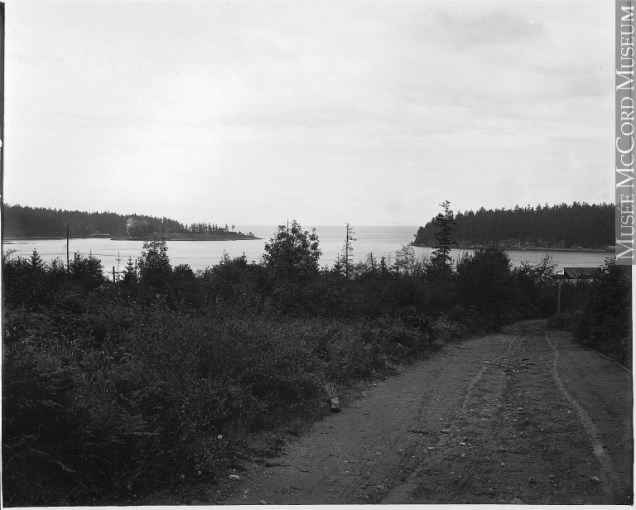
In the mid-1960s, former CIL land at Departure Bay was developed by Frank Ney’s Great National Land and Investment Corporation into a 220-lot subdivision. The “waterfront subdivision included all of the modern services and received plenty of flack from residents who objected to the unusually large number of trees that had to be removed to accommodate the project. However, it proved to be one of B.C.’s finest developments.”14 The subdivision was one of the first to have underground services and featured magnificent views of Departure Bay. The waterfront lots sold for just a fraction of their value today. The name of the subdivision? Cilaire, with the letters C-I-L paying tribute to the land’s earlier days under the CIL banner. There is little tangible evidence of CIL’s time in Nanaimo, just part of a concrete retaining wall and a few old footings from the company wharf, but the name and the stories continue to live on as part of Nanaimo’s history.
Notes
Douglas Steel, Nanaimo Past & Present: Stories of the City (Nanaimo, BC: Steelbro, 2013), 1.
“Representative Business Men of Nelson and the Kootenays: Hamilton Powder Company,” The Daily News, September 24, 1910, 4, http://dx.doi.org/14288/1.0383752.
“The Dynamite Plant at Departure Bay,” in Nanaimo Retrospective: The First Century, ed. E. Blanche Norcross (Nanaimo, BC: Nanaimo Historical Society, 1979), 146.
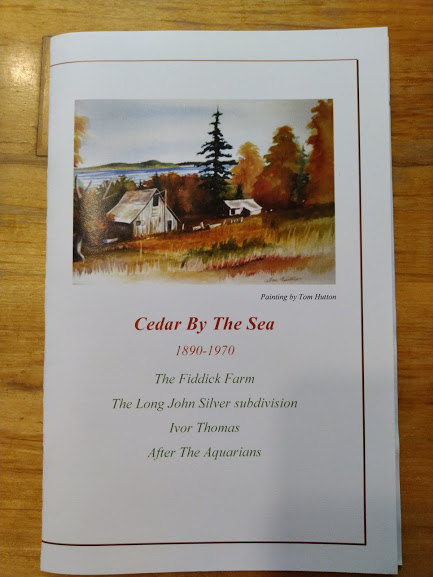
A new, ultra local read! I first learned about the booklet, “Cedar By The Sea: 1890-1970” compiled by Roger Prior in the fall newsletter of the Nanaimo Historical Society. Since I live in Cedar myself, and I also like to support the creative work of fellow NHS members, it was a definite must-have! Only a limited number of copies have been produced, so I’m happy to have one to add to my always expanding local history library.
In his NHS newsletter article, Prior expressed that he felt that the history of Cedar’s early settlers was not well-known (I’d agree), and that he hoped that his “modest little booklet might help to recognize the endurance and vision of [Cedar’s] pioneers.” It’s so easy for stories to get forgotten if they aren’t recorded in any way. Local history matters, and I’m happy to see someone else writing about the history and development of the often overlooked small communities that surround Nanaimo.
The first and most lengthy section of the booklet features the Fiddick family, who moved to the Cedar area in 1872. Samuel and Elizabeth (Grandam) Fiddick pre-empted 250 acres on the west side of the Nanaimo River, building a home at the corner of Wilkinson and Akenhead Roads. Their son Charles later purchased 120 acres near Dodd Narrows, a property that was uncleared and included a quarter of a mile of waterfront. Charles Fiddick developed the land and moved his family into a house there in 1904, and descendants of the Fiddick family still live in the immediate area today.
Next there is a brief section in the booklet about the Long John Silver subdivision, which was developed by the realty company of Nanaimo’s pirate mayor Frank Ney on land purchased from the Fiddick family in 1963.
The next section features the Thomas family that first pre-empted land in Cedar in 1884. The Thomas family section is particularly focused on long time Cedar resident Ivor Thomas who lived in the area from his birth in 1889 to his death in 1981.
The final section of the booklet is about the Aquarian Foundation property. It was nice to see that Prior did not spend a lot of time on the mysterious (but sometimes over-embellished) tale of Brother XII that’s been covered at length elsewhere. Instead, the property itself is the focus in the booklet and what happened to the land and different buildings after the foundation dissolved and Brother XII and his followers dispersed.
I really appreciate the effort that goes into producing this kind of local history resource: peering at old newspapers, sorting through albums and boxes of photos, conducting interviews with neighbours, and exploring the resources of the Nanaimo Community Archives. As I contemplate my own writing ideas, I was pleased to read that Prior found his project to have a community building element. He shared that he “used the project as an introduction to even more neighbours and locals who added more of their memories.” The idea that neighbours can be brought together in the spirit of local history project is definitely one that I can get behind and something I will be thinking about in the future.
Two new ultra-local reads! I purchased both of these books directly from the authors, which I was happy to do in theses strange COVID-19 times. Each book is biographical, following the life and times of a different yet contemporary white, male, colonial pioneer who spent time in Nanaimo.
McDowell, Jim. Pluck, Luck and Grit: Charles A. Bayley in Colonial British Columbia (1851-1869). Richmond, BC: JEM Publications, 2018.
Davidson, Carole. Early Nanaimo 1857-1876 from the Diary of William J Hughes. Victoria: Rendezvous Historic Press, 2020.
Pluck, Luck and Grit: Charles A. Bayley in Colonial British Columbia (1851-1869) was published by Jim McDowell in 2018. I recently learned about it when it was briefly profiled in the books section of the Summer 2020 issue of British Columbia History magazine. McDowell is a BC historian with several titles to his name. He only self-published a very small number (12!) of limited edition, full colour copies of Pluck, Luck and Grit, and I feel lucky to have one. The book follows the life of Charles Bayley, who came to Vancouver Island with his parents in 1850 aboard the Tory. The ship had been chartered by the Hudson’s Bay Company “to carry a few ‘settlers’ and numerous labourers around the horn of South America and north in the Pacific Ocean in order to start colonizing the Pacific Northwest Coast for Great Britain.”1 The Bayley family settled three miles from Fort Victoria, where Charles’ father Thomas was contracted by the HBC to manage a farm. Charles Bayley went on to become one of Vancouver Island’s earliest schoolteachers, working first in Victoria and then later in Nanaimo. According to the book’s dedication, McDowell’s mother was Charles Bayley’s “grand niece-in-law,” and her brother, McDowell’s uncle, was married to a granddaughter of Bayley. This connection likely gave McDowell access to Bayley’s memoirs, quotes from which are included in the text, adding Bayley’s own voice to the narrative.
Early Nanaimo 1857-1876 from the Diary of William J Hughes by Carole Davidson was just published this year and follows Hughes’ life as depicted in his daily (only one line per day) diary. Nanaimo history fans may be familiar with Davidson’s earlier book, Historic Departure Bay…Looking Back, which was published in 2006. Hughes and his Indigenous wife Mary Salacelowitz settled on a piece of land at Departure Bay in 1861, where they farmed, gardened, and generally seemed to work hard to earn their living. Mary, who was from the Cowichan Tribes, followed the traditional ways and annual seasonal patterns of her people. She frequently spent time away from home and took the children with her, while William’s days seemed to be mostly full of never-ending chores and work to support their family and property.
If I come away from a book about Vancouver Island having read one thing I didn’t know already, I’m usually pretty happy, and that certainly was the case for both of these books which cover some of the Island’s early settler history. For example, Davidson’s book explains how the land at Departure Bay where Robert Dunsmuir built his coal shipping wharves for the Wellington Colliery was originally part of William Hughes’ 150-acre pre-emption. Having read a lot about Dunsmuir, it’s not hard for me to imagine the canny Scot bullying Hughes into entering a lease agreement which gave Dunsmuir access to tidewater through Hughes’ land. Surprise, surprise, not only did Dunsmuir apparently go ahead and build a road and wharves on William Hughes’ land before sorting out the details of the lease agreement, but he also petitioned the Legislative Assembly to be allowed to appropriate even more of Hughes’ land for his use:
“The original lease granted Dunsmuir a strip of land thirty-three feet wide from the mine to the sea with one acre of land at the waterfront. The new petition asked for sixty-six feet of land from the mine and five acres of land at the seafront. William makes no comment in his diary to indicate his feelings about this second intrusion on his land, but one can assume he wasn’t happy as under these new terms his house was separated from the rest of his land.”2
What a guy! Robert Dunsmuir sure didn’t become one of the richest men in the province by playing nice with the neighbours. His “robber baron” label certainly seems to fit in this case. In her biography, Robert Dunsmuir: Laird of the Mines, local historian Lynne Bowen looked at the range of ways in which Dunsmuir was described after his death. A claim that he was “a man who knew what he wanted and took the shortest route”3 seems to perfectly describe how Dunsmuir dealt with Hughes.
A wonderful, trivial fact about Victoria is shared in McDowell’s book. Because of how his hotel was built on the corner of Government and Yates Streets, Charles Bayley left a lasting mark on the city. Apparently, there is what McDowell calls a “jog” in Yates Street, where Bayley “inadvertently built his hotel [in 1857] without allowing for a setback from the street line. Instead of relocating what was then Victoria’s finest building, surveyors simply shifted their measuring pegs, and created a slightly dysfunctional, unattractive ‘jog’ along the entire block which still exists.”4 McDowell goes on to suggest that “this engineering oddity deserves recognition by a modest, amusing historical marker,”5 and I can’t say that I disagree with him!
It was interesting to read these two books together. While they both cover relatively the same time period, in relatively the same place, the lives of Bayley and Hughes, two white men of a similar age, are significantly different. Bayley’s days in Nanaimo, which was called Colviletown at the time, were spent teaching the children of the settlement’s miners and HBC employees. “The census [of 1854] indicated Bayley had 29 (apparently all male) students,”6and because a proper schoolhouse had not yet been built, he used a single room in a small, wood-frame cabin as his schoolroom. Bayley received a salary and his board (at the home of his future wife’s parents) was also paid. It seems like Bayley must have enjoyed a reasonably comfortable lifestyle, as by the end of 1856, after just three years of teaching in Nanaimo, he had enough of a nest egg to enable him to change careers and cities. “Tired of the monotony of the sedentary life of a teacher and having saved a few thousand dollars, [he decided to] embark on a more active life as a trader [in Victoria].”7Bayley’s cash flow wasn’t always so stable, and in 1868, he took out an advertisement in Victoria’s British Colonist claiming his time was not “fully occupied” and he was looking for work he could do. As McDowell puts it: “One can sense how humiliating it must have been for a man…to be forced to publicly beg for work behind the thinly-veiled pretense of simply having too much time on his hands.”8
In contrast, Hughes certainly didn’t lead a life of comfort or one where he found himself sticking much money aside for future plans. When he died in 1876, “the value of his effects was less than $820.”9The “monotony of life” for Hughes meant day after day of work. “He worked from dawn to dusk, seven days a week to feed his family, and to improve his land and living conditions.”10 Unlike Bayley, who could change occupations on a whim out a desire for something more fulfilling or lucrative, Hughes seemingly took any job that he could in order to just survive.
Although living markedly differently day-to-day lives, both men experienced instability. Charles Bayley moved from England to Victoria, to Nanaimo, back to Victoria, and then to San Francisco in the space of two decades. During the first years of his diary, Hughes moves around so much that Davidson isn’t actually able to determine where he really lived. He does eventually settle and file a pre-emption for land in Departure Bay in 1861, but even after that, he still spends time going back and forth to Newcastle Island, and also making fairly regular trips to Nanaimo, Victoria, and to St. Ann’s in Duncan where his children attended school.
Bayley shuffled from career to career, apparently not finding success or contentment with any one thing. After teaching for a few years, he went on to become a hotelier and storekeeper, next a gentleman farmer, and then a politician. He also tried to make money by investing in mining goods and equipment then hiring someone else to take the supplies in a pack train to where they could be resold for a profit. Bayley sent a pack train to Williams Creek (outside of Barkerville) to capitalize on the Cariboo gold rush, and he later funded a similar venture bound for the Leech River (outside of Sooke) where a gold bonanza happened briefly in 1865. McDowell describes Bayley as “a venturesome fellow who knew how to seize a new opportunity or meet an unexpected challenge when it appeared.”11
Hughes also moved from one job to the next, all of them apparently temporary. He seems to have made a large portion of his living by periodically crafting tool handles, selling fish oil he’d rendered down from dogfish livers, and through his farming ventures. Davidson proposes that he may even have been running one of Vancouver Island’s early nurseries, based on the large number of fruit trees he cared for. “The number of young trees produced seemed to be many more than he would use himself which leads one to suppose that he grew them for resale.”12Hughes also tried his hand at gold mining outside of Yale, spent time at the quarry on Newcastle Island, and carried out small building projects. His diary reflects a life of constant chores and hard work with little room for luxury, rest, or frivolity.
I’m pretty sure the two men would not have been friends or even friendly acquaintances. McDowell frequently makes note of the stereotypes that Bayley upheld. He didn’t think much of the labouring classes, which Hughes certainly would have belonged to. “Bayley’s condescending references to a ‘medley of various characters’ and ‘incorrigible’ country folk in steerage indicate stereotypes and biases about labouring class people that aspiring ‘squires’ [like Bayley and his family] brought with them.”13Bayley also had little respect for the Indigenous Peoples of the land, and at times apparently didn’t even acknowledge them. “Bayley’s unspoken, but obvious exclusion of Indigenous people from his estimate of the town’s population count rendered this group non-existent.”14 While Bayley might have summoned the respect to acknowledge Hughes in his store or on the streets of Nanaimo, he likely wouldn’t have looked favourably on Hughes’ choice of an Indigenous woman for a partner, and in all probability, he wouldn’t have treated the mixed-raced children of the Hughes union in the same way he treated the children of the white settlers of the community. I appreciated how McDowell wasn’t shy about critiquing the condescending and racist references in Bayley’s memoirs, and how he notes how Bayley’s views reflected a “narrow-minded 19th century colonial socio-cultural perspective [that] would remain largely unchanged in British Columbia for more than 100 years.”15
Like many self or community published titles, both of these books could have benefited with some additional editorial oversight, as they each include an assortment of minor spelling, punctuation, and grammar errors as well as some inconsistencies in font and format choices. But overall, I enjoyed reading both Davidson’s and McDowell’s latest books, and I will certainly look forward to anything they might publish in the future about the history of Vancouver Island.
Notes
Jim McDowell, Pluck, Luck and Grit: Charles A. Bayley in Colonial British Columbia (1851-1869) (Richmond, BC: JEM Publications, 2018), 11.
Carole Davidson, Early Nanaimo from the Diary of William J Hughes (Victoria: Rendezvous Historic Press, 2020), 103.
Lynne Bowen, Robert Dunsmuir: Laird of the Mines (Lantzville: XYZ Publishing, 1999), 141.
I’m happy to be writing a series of blog posts about my great-grandparents, Ole Olsen and Konstanse Fyhn. This second installment is the story of my great-grandmother’s journey from Norway to Hagensborg, British Columbia in the spring of 1914, including thoughts about some possible reasons for her emigration as a young, single woman. Konstanse settled in the Bella Coola Valley, joining an aunt and uncle whom had emigrated earlier. Before the year was out, she found herself a bride, marrying my great-grandfather, Ole Olsen, in December of 1914.
Konstanse Wilhelmine Aminda Fyhn left Norway for Bella Coola, British Columbia in the spring of 1914, when she was just 19 years old. Several generations and over 100 years later, it’s difficult to determine Konstanse’s motivations for leaving Norway, but one can speculate. Family legend points to a problematic relationship with a Norwegian man (the brother of the wife of one of Konstanse’s half-brothers) as the likely reason for her emigration.
Konstanse seated at left with Lars Martinsen standing behind her. The other couple pictured is Konstanse’s eldest half-brother, Anders Fyhn, and his wife Alette, who was Lars’ sister.
Apparently, both the boyfriend’s family and Konstanse’s own mother were not supportive of the match. Lars Martinsen “had been her boyfriend for a while, at least two years.”1 The relationship was serious enough that Konstanse and Lars had their photo taken together with another couple – Konstanse’s half-brother Anders and his wife, Alette, who was Lars’ sister. Was the photo a promise or a dream of a life together for Lars and Konstanse?
A letter my grandmother, one of Konstanse’s daughters, received from her Norwegian cousin reflects on Konstanse’s emigration and Konstanse’s mother’s views about the young couple:
“Maybe the main reason why grandmother wanted [Konstanse] to go was that she didn’t like aunt’s boyfriend Lars. Aunt was rather young. Maybe grandmother was afraid that the same thing should happen to aunt as to herself. She had three children before she was married. Two of them died early. The third, Johan, lived until he was five years old. Grandma was put in prison for a little while for this. It was like that at the time in Norway, that the girl was punished. The boys were innocent.”2
Was Konstanse sent away by her family to prevent a deepening relationship with her boyfriend? It’s entirely possible. However, it’s also possible that a determined young woman just wanted to create her own adventure in the new world. Immigration historian Theodore C. Blegen reminds us that: “Since the days of Puritan and Cavalier, children of the Old World have thronged to the shores of the New seeking well-being and happiness.”3 After years of being raised as the only daughter among sons, perhaps Konstanse wanted to escape a life of doing unpaid chores for her parents and six brothers. Or perhaps she just didn’t see any favourable social or economic opportunities for herself if she stayed in Norway.
“Women, like men, responded to economic opportunities abroad. As the Norwegian Bureau of the Census concludes, ‘From the earliest beginnings the main reason for emigration from Norway seems to have been young people’s desire to improve their economic circumstances.’ Nineteenth-century Norway, the bureau explains, was not considered well developed economically, and opportunities for advancement or a living wage were grossly inferior.”4
Norwegian historian Ingrid Semmingson writes that “to 1914 America became the prime goal of the wanderlust of impecunious Norwegian young people.”5Konstanse was young, she was unmarried, she was from a small fishing village in rural, northern Norway, and she was the only daughter of a large family. Perhaps she didn’t see her life playing out the way she dreamed. During the period from 1866 to 1940, women accounted for 41% of Norwegian immigration to overseas countries, and “most women, like men, were not married and immigration might represent a liberating aspect of their lives.”6
So when an opportunity to travel to the New World came up, perhaps she was ready and willing to go – to break free and take charge of her own life, and to assert her independence. And what was that opportunity? Companions to travel with.
Konstanse’s niece thought that Konstanse travelled as part of a group: “I’ve heard that a member of a family, that was from this area, that had emigrated to Amerika was here [back in Norway] visiting. It was said that if they brought with them another person from Norway to Amerika, then they wouldn’t be charged anything for the return ticket.”7
Konstanse did travel as part of a group. Her aunt, her father’s sister Nille, was married to a man named Eilert Knudsen. Nille and Eilert had immigrated to Canada in 1907, settling in Hagensborg, a Norwegian community in the Bella Coola Valley. Eilert’s brother Kasper Knudsen, Kasper’s wife Hanna, and Kasper and Hanna’s two youngest sons must have decided to join not only Nille and Eilert, but also the two eldest Knudsen children, who were already in the Bella Coola Valley. Konstanse travelled with the Knudsens on their journey to Canada. Her name can be found together with theirs on the manifest of the Allan Line’s Victorian.
So, although Kasper and Hanna Knudsen were not emigrants back in Norway visiting, they were headed to Amerika – the land of new chances – and Konstanse took the opportunity to join them on their journey. While not closely related, Konstanse likely would have known her uncle’s family, as they also were from the same Norwegian county, and she and her parents all must have felt more comfortable about the long journey ahead knowing she was travelling with trusted companions.
The mention of the Knudsen party’s arrival in the March 28, 1914 issue of the Bella Coola Courier gets almost as many details wrong as it gets right, but I’m quite confident it is Konstanse’s travel group being described and she is the “daughter” mentioned:
“S.S. Camosun arrived in port on Sunday last with the usual large number of passengers. Mr. and Mrs. Kasperson, three sons and a daughter, arrived by last Sunday’s steamer and intend to settle in the valley. They came from Norway by the Allan Line of steamers, purchasing their tickets through the steamship company’s local agent at Bella Coola. Mr. and Mrs. Kasperson have relatives and friends in the valley.”8
Along with Konstanse, Kasper and Hanna Knudsen travelled with their two sons, 15-year-old Morten Kasperson, and 11-year-old Jorgen Kasperson. The ship’s manifest from the Victorian, shows another young man grouped together with the Knudsen family and Konstanse, 24-year-old Johan Fredricksen, who declared himself a farm labourer. Perhaps he was coming to help the Knudsen family make their new start in the Bella Coola Valley.
Fyhn family home in Lattervik, Norway – Photo by Marcy Green
The Fyhn family house in Lattervik in the Troms County of northern Norway is still home to Fyhns today. A granddaughter of Konstanse’s brother Anfinn Fyhn lives there now, and recently welcomed two of my father’s brothers to Norway for a visit. My relatives there have the sense that Konstanse left in sadness, which agrees with the letter my grandmother received from her Norwegian cousin: “The day aunt [Konstanse] left, my mother walked with her to Jægervatnet [a village about 10 kilometres away from Lattervik]. Aunt wasn’t happy the day she had to leave everything she cared about in Norway.”9
While I love the idea of my great-grandmother being an adventurous woman of action, if Konstanse left Norway in great sadness, she doesn’t sound very much like a young adventurer, eager to make a new start in an exciting new land. While it’s impossible to know the actual motivations for her emigration from Norway, I do know the spring of 1914 found Konstanse sailing from Liverpool with the Knudsens and landing at St. John, New Brunswick. She travelled seven days by train across Canada, arriving in Vancouver for the final leg of her journey by steamship to Bella Coola. Once there, she joined her aunt Nille and uncle Eilert.
After arriving in Bella Coola, Konstanse may have worked as a mother’s helper for early colonists Mattie and Barney Brynildsen (whom a Norwegian relative tells me may also have been relatives of Konstanse’s), helping with their two young boys, Robert and Alger. A family story spins the romantic yarn that each of Hagensborg’s three Olsen brothers, Ole, Ingvald, and Paul, initially attempted to woo the newly arrived Konstanse, but she picked Ole as her match.
My great-grandparents, Konstanse Fyhn & Ole Olsen on their wedding day in 1914.
Konstanse’s memory of the first time she met her husband-to-be was shared with a granddaughter: “It was on a Sunday in church that I first saw him. I was wearing my new green coat and hat and looked my best. Your grandfather was a fine figure of a man, and I decided that I would marry him.”10 The couple was married on December 23, 1914, in the home of Ole T. and Mina Ovesen in Hagensborg.
Ole and Konstanse lived in a frame house built by Ole on a 22-acre property bounded by the river. When the river’s path changed, their farm became an island, accessed either from the Salloompt Valley by the main Salloompt bridge, or from Hagensborg by the smaller Branch bridge. The Olsens’ first son, John, was born in 1915, with Arnold (1919), Einar (1922), Olive (1925), twins Herbert and Henry (1927), my grandmother Eva (1929), Eleanor (1930), and Robert (1934) following after.
The Olsens stayed in the Bella Coola Valley until their home was damaged by a great flood in October 1934, after which, together with Ole’s brothers’ families, they moved to Sidney on Vancouver Island.
Notes
Aagoth Fyhn, “Why Konstanse Fyhn Emigrated to Canada,” interview by Per-Kristian Fyhn, July 25, 2010.
Aagoth Fyhn, letter to Eva Johnson, December 13, 1995.
Theodore C. Blegen, Norwegian Migration to America 1825-1860 (Northfield, MN: The Norwegian-American Historical Association, 1931), v, HathiTrust Digital Library, https://catalog.hathitrust.org/Record/000622642.
Betty A. Bergland, and Lori Ann Lahlum, Norwegian American Women: Migration, Communities, and Identities (St. Paul, MN: Minnesota Historical Society Press, 2011), 62, muse.jhu.edu/book/2013.
Ingrid Semmingsen, Norway To America: A History of the Migration (Minneapolis, MN: University of Minnesota Press, 1980), 119, ProQuest Ebook Central.
Bergland, 54.
Fyhn, letter.
“Jottings of Bella Coola and District,” Bella Coola Courier, March 28, 1914. BC Historical Newspapers, UBC Open Collection, http://dx.doi.org/10.14288/1.0170090.
Fyhn, interview.
Marcy (Olsen) Green, “An Immigrant’s Journey: The Olsen Family,” The Vancouver Sun, April 29, 2008, B3.
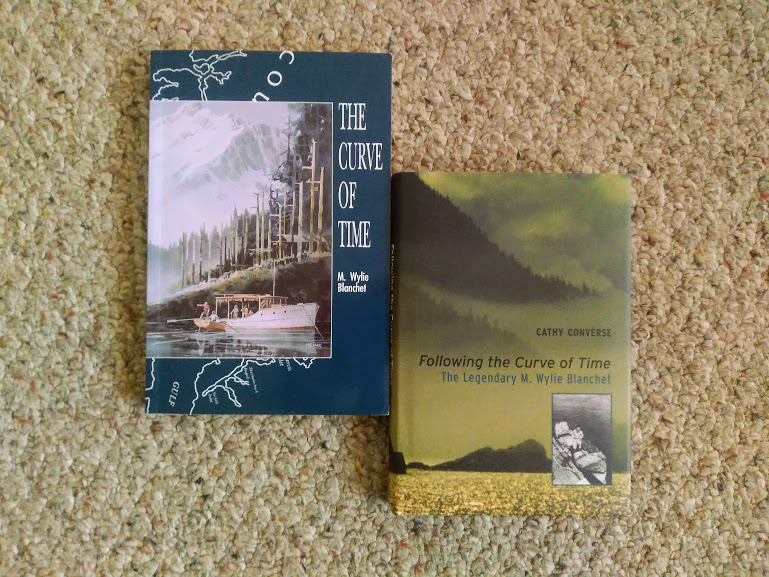
A flotilla of coastal cruising books! I just read The Curve of Time by M. Wylie Blanchet, and immediately following in its wake, I read the biography Following the Curve of Time: The Legendary M. Wylie Blanchet by Cathy Converse. Despite living on an island, I really don’t have any experience with boating, yet I thoroughly enjoyed reading about the marine adventures of Muriel Wylie “Capi” Blanchet that took place during the many summers she cruised the B.C. coast with her children in the 1920s and ’30s.
After her husband’s sudden and unexpected death, Blanchet loaded her five children into the family’s 25-foot boat, Caprice, and for year after year they spent from early June to late September adventuring in the coastal waters of British Columbia. The living and storage space aboard the Caprice was very small and was strictly organized out of necessity. I can’t imagine telling my own brood that they could only have one change of clothes, a set of pajamas, and a bathing suit for an entire summer! The book Blanchet wrote about the family’s years of summer cruising, The Curve of Time, has “become one of the classics in British Columbia literature.”1
At times pensive, while at other times quite humorous, I enjoyed Blanchet’s writing style. Her love and concern for her children comes through clearly in her prose. As a parent myself, my eyes raced across the page as Capi frantically returned from her foray into the forest to where her children played alone on the beach:
“‘Coming – coming!’ I shouted. What was I going to rescue them from? I didn’t know, but how desperately urgent it was! I finally scrambled through to the beach – blood streaming down my legs, face scratched, hands torn – blood everywhere. Five wondering faces looked at me in horror. The two youngest burst into tears at the sight of this remnant of what had once been their Mummy. ‘Are you all right?’ I gasped – with a sudden seething mixture of anger and relief at finding them alive and unhurt.”2
What parent hasn’t had a sudden flash of intuition that something was wrong with the children, followed by an urgent panic to check that everything is alright!?
Reading Converse’s biography about Blanchet gave me meaningful context and answered a lot of my questions. At no point in Blanchet’s book is the reader told what had happened to Capi’s husband, only that he had recently died before Capi and the children started taking their summer journeys. After finding out in Converse’s biography that Geoffrey Blanchet disappeared while out alone on the Caprice, I was even more amazed at Capi’s courage and strength.
For a woman to face grief head on like that, on the very boat that her husband disappeared from, really drove home for me what a strong person Capi was. I have to say, if I was in the same position, I find it very unlikely I would embrace boating as a pastime when my spouse had died doing that same activity. And I certainly wouldn’t find myself living on the same boat that he had disappeared from. But as Capi wrote, “Destiny rarely follows the pattern we would choose for it and the legacy of death often shapes our lives in ways we could not imagine.”3
Converse’s biography also outlines Blanchet’s life before her Caprice days. Growing up on the St. Lawrence River and summering in Cacouna, Quebec, she developed a love of water from an early age: “It was in Cacouna that Capi explored and honed her skills as an observer of the natural world, and this would set the tone and direction of her life in British Columbia.”4
Reading The Curve of Time in 2019, I was uncomfortable with the Blanchet family’s intrusions into several First Nations villages on the B.C. coast. The Blanchets not only wandered into abandoned villages, handled, photographed, and even removed some artifacts that they found there, but Capi also ignored locks and warning signs.
Converse explains to readers that during the time period of both when the Blanchets were adventuring and when the book was originally published in 1961, attitudes and practices were different than today: “There are now legal protections against the removal of indigenous property, but in Capi’s time no such regulations existed and cultural sensitivities were discounted.”5
While Converse’s reminder does help to situate the Blanchets’ actions in a time period when settler behaviours and attitudes served to damage traditional First Nations cultures of the B.C. coast, the sections about the Blanchets’ explorations of First Nations villages still sat uneasily with me long after I put The Curve of Time down.
Blanchet explains the family’s rationale: “We had made up our minds to spend part of the summer among the old villages with the big community houses, and try to recapture something of a Past [sic] that will soon be gone forever.”6 The thing is, at least some of the villages the Blanchets visited likely weren’t ‘old’ in the sense that they were abandoned. And the inhabitants’ lives weren’t something of the past. The people who lived in some of the villages likely just happened to be away at the time of the Blanchets’ uninvited and most likely unwelcome visit.
In her exploration of colonial women’s travel writing regarding contact with Indigenous peoples, author Dr. Nancy Pagh explains how Blanchet has employed a myth common to literature of the time period: “When Blanchet constructs Native people as the embodiment of ‘the Past’ [sic], she refuses to allow that these very real people are her contemporaries, alive and working in the summer fishery while she is fantasizing about them from their winter villages.”7
Capi trespassed and took things that weren’t hers, and in her book, she doesn’t seem to show any regret or remorse in doing so, even though The Curve of Time was written many years after her summer cruises. She even goes so far as to recount how in one empty First Nations village, the Blanchet family, “played with their old boxes-for-the-dead, trying to see if we could fit in.”8Knowing that The Curve of Time still serves as a key text for those cruising the B.C. coast, I hope that anyone reading the book today isn’t encouraged to act in a similar manner in the event of finding an Indigenous artifact during their own adventures.
As her children grew, some of them no longer joined Capi for the family summer holiday, and the early 1940s and World War II brought the last cruise aboard the Caprice. In the biography, Converse outlines the remainder of Capi’s life on Curtesis Point on the Saanich Peninsula, and briefly summarizes the later lives of the five Blanchet children.
Overall, I found it meaningful and interesting to read the books together as a pair. Once I knew more of Capi Blanchet’s story than she revealed in her own writing, I was quite intrigued by this enigmatic woman from Vancouver Island, and I was curious to read more about her. As well as being mentioned in Pagh’s book, At Home Afloat: Women on the Waters of the Pacific Northwest, Capi Blanchet is profiled in Eve Lazarus’ book, Sensational Victoria: Bright Lights, Red Lights, Murders, Ghosts & Gardens, as one of five legendary women of Victoria. Author and historian Rosemary Neering, whose many books have focused on western Canada, includes a section about Blanchet in her book, Wild West Women: Travellers, Adventurers and Rebels. And in The Strangers Next Door, Edith Iglauer, a leading chronicler of Canadian life and culture, devotes a chapter to Blanchet, which originally appeared in Raincoast Chronicles, the well-loved journal of the Canadian west coast.
Converse adeptly covers much of this same material in the biography, but it was still interesting to read other authors’ takes on Capi. Lazarus includes a quote from Blanchet’s daughter-in-law that reminds us that The Curve of Time is after all an “account” of the Blanchets’ cruises, one that “is neither a story nor a log”9: “When I read The Curve of Time when it was first published, my governing thought was this was not the woman that I knew, because Capi comes across much more tender and sensitive in that book than she appeared to me.”10
How much did Capi Blanchet blur the lines between fact and fiction in The Curve of Time? Converse reveals that the Blanchet children were not necessarily in agreement about the accuracy of Capi’s writing: “When Elizabeth, who became an accomplished writer in her own right, first read her mother’s book, she remarked, ‘A lot of what is in that book is bunk. I ought to know, I was there.’ Some of the others chose not to read it or did not comment on it.”11
So much of Capi Blanchet’s life remains a mystery, including what her real motivation was for packing her children aboard the Caprice for those long summer cruises. Did she just need the money she received from renting out the Blanchets’ Little House over the summer? Was it the pull of adventure? An act of defiance and confidence building when her family expected her to go back east after her husband’s sudden death? Or was it just that she loved being out on the water, cruising and exploring, and she wanted to share a pastime that she enjoyed with her children? We’ll never really know, but I definitely enjoyed reading about Capi Blanchet, a remarkable west coast woman.
Notes
Iglauer, Edith. “‘Capi’ Blanchet.” In The Strangers Next Door (Madeira Park, BC: Harbour Publishing, 1991), 222.
Blanchet, M. Wylie. The Curve of Time (Vancouver: Whitecap Books, 1996), 3.
Blanchet, 161.
Converse, Cathy. Following the Curve of Time: The Legendary M. Wylie Blanchet (Victoria, BC: TouchWood Editions, 2008), 29.
Converse, 143.
Blanchet, 45.
Pagh, Nancy. At Home Afloat: Women on the Waters of the Pacific Northwest (Calgary: University of Calgary Press, 2001), 114.
Erling Isador Johnson
December 10, 1925 – May 3, 2019
“Together Forever”
It is with heavy hearts we say goodbye to our loving parents, grandparents, and great-grandparents, Erling and Eva Johnson, who passed away within hours of each other in Williams Lake on May 2nd and 3rd, 2019.
They leave behind many memories for their ten children: Chris (Tina), Ingrid (Jerry), Darrell (Maechlin), Paul (Pauline), Bruce (Jackie), Byron (Laurie), Stephen (Rubina), Garth (Coleen), Ben (Tanya), and James (Kim), as well as their 22 grandchildren and a growing number of great-grandchildren.
Eva was predeceased by her parents, Ole and Konstanse Olsen, as well as her brothers John, Arnold, Einar, Hank, and Robert, and her sister Olive Broomfield. She is survived by her brother Herbert and her sister Eleanor Perron.
Erling was predeceased by his parents, Ted and Elfreda Johnson, as well as his sister Irene Fulla. He is survived by his younger sister Ivy Stubbs. Eva and Erling are also survived by numerous nieces, nephews, cousins, and extended family members in Canada, Sweden, and Norway.
Remembered for their devotion to both their family and their Christian faith, Eva and Erling were married for almost 67 years. They shared a wonderful life together that was a model for all our family, and they will be greatly missed. During this difficult time, the family takes comfort in knowing that Eva and Erling’s walk throughout their married lives was always in step with one another, and with the Lord.
The eldest child of Swedish immigrants, Ted and Elfreda (Stenvall) Johnson, Erling Isador Johnson was born in Sylvan Lake, Alberta on December 10th, 1925. After a difficult time spent attempting to farm, Erling’s parents moved the family to Smithers in the late 1920s. In 1938, the family moved again, this time to Nanaimo, on Vancouver Island, where Erling attended John Shaw High School.
After graduating, Erling attended Grade 13 in Vancouver, in preparation for university. But instead of heading off to UBC as planned, he enlisted in the Canadian Army on August 3rd, 1944, at age 18. He was trained in Vancouver and England and was sent to Holland in 1945. Discharged on December 4th, 1945, Erling enrolled in the Forestry program at UBC, and as an Armed Forces veteran, his tuition was paid.
Erling is remembered for his great patience and kindness. He was so proud of all his children, and he loved to tell stories of their many accomplishments.
Eva Joy Olsen was born in Hagensborg, outside Bella Coola, on December 30th, 1929, to Norwegian immigrant parents Ole and Konstanse (Fyhn) Olsen.
The Olsens moved away from the Bella Coola Valley in early 1935, after their home was damaged by a great flood from which the family had to be rescued. The family moved to Sidney on Vancouver Island, and although her older siblings felt the strain of the move, Eva loved growing up there, and living near Roberts Bay. She remembered the family growing strong ties within their church community, and she had fond memories of days spent on the beach.
In 1942, the Olsens moved to Nanaimo, where Eva attended John Shaw High School. She got her first job in an accountant’s office when she was 17, and she also worked for a few years in the office at Northwest Bay Logging Company.
Eva is remembered for her lovely singing voice, which graced not only family events and church functions, but also could be heard during quiet moments at home.
Eva and Erling first met in 1947. Thinking back on the day they met, Eva wrote in her journal: “He walked into our church, and I promptly fell in love.” The couple were married in Nanaimo, on June 21st, 1952, after Erling received his degree and was working in the forest industry.
Living in Nanaimo on St. Andrews Street, the Johnsons started a family of their own. Christopher, Ingrid, Darrell, and Paul were born in Nanaimo. Sons Bruce, Byron, Stephen, Garth, Benjamin, and James followed after the family moved to the Cowichan Valley.
In the late 1950s, the family moved to Nitinat, a logging camp at Kissinger Lake. By 1962, they had moved to Lake Cowichan, and four years later, they moved to Herd Road, outside of Maple Bay. They lived at the Herd Road house for about eight years before moving to a rented home in Duncan, and then to their own home in Crofton.
In 1976, the family moved to property outside of 100 Mile House. Over the next 30 years, Eva and Erling, with the help of their sons, developed a ranch at Upper Lake, and enjoyed a rural lifestyle.
With their children grown up with families of their own, Erling and Eva fulfilled their long-time dream of moving back to Vancouver Island in 2006. They settled in French Creek, enjoying a life of retirement by the ocean’s shore.
In 2015, Erling and Eva returned to the Cariboo. They were happy to have loving family members visit them at the Williams Lake Seniors Village, offering comfort and support during their final years.
The family would like to thank the staff at the Williams Lake Seniors Village, and a special thank you to Dr. Schreve. A memorial service for the Johnsons was held on Saturday, May 11th at the Cariboo Christian Life Fellowship Church at the 108 Mile Ranch. In remembrance of Erling and Eva, donations can be made to Cal Bombay Ministries, a charity which the Johnsons supported for many years.
I’m happy to be writing a series of blog posts about my great-grandparents, Ole Olsen and Konstanse Fyhn. This first part of the story is a look at my great-grandfather, Ole Kristian Kaspersen Olsen, including his emigration from Norway, his eventual settlement in the Bella Coola Valley with his two brothers Ingvald and Paul, and his marriage to my great-grandmother, Konstanse Fyhn, in 1914.
By October of 1912, my great-grandfather, Ole Kristian Kaspersen Olsen, was living in the Bella Coola Valley. He and his younger brother, Ingvald, had settled in Hagensborg, the Norwegian community that had been established approximately 20 kilometres east of the Bella Coola townsite. Ole and Ingvald’s younger sibling, Paul, had joined his brothers by 1913. Prior to his arrival in Hagensborg, Ole had left Norway, landed in New York, and lived in Minnesota for about a year. In the early 1900s, Ole’s two elder sisters, Konstanse and Eleonora, had immigrated separately from the family’s home in Helgeland, a district in the Nordland County in northern Norway, to Minnesota, where large numbers of Norwegians had been settling since the 1860s.1
The 1910 US Census indicates that Ole’s eldest sister, Konstanse, was the first of the family to leave, emigrating from Norway in 1901. She married Iver Bottolfson in 1905, and settled in Freeborn County, Minnesota. The 1920 US Census shows that Nora immigrated next in 1906, likely to join her sister. In 1908, Nora married Mandius Monson in Freeborn, and remained there until her death in 1948. Both Bottolfson and Monson were American born sons of Norwegian immigrants. It’s likely that Ole joined his sisters and their families with thoughts of starting a farm of his own in Minnesota.
Ole was the second son in the large Kaspersen family. It would have been expected that his elder brother, Arthur, would inherit the entirety of the family’s farm. Many parts of Norway are dominated by mountains, with only a small portion of the country suitable for farming. At the start of the 20th century, Norway was one of the poorest countries in Europe.2 Poverty and a lack of land opportunities, combined with the odel system of land tenure in Norway, which dictated that only the oldest son – the “odelsgutt” – inherited the farm, saw many younger sons immigrating to ‘Amerika’.3
Ole Kristian Kaspersen Olsen is seated on the far left; his older brother, Arthur Rosenius, is seated beside him; a man who is possibly his brother-in-law, Iver Bottolfson (husband of his eldest sister Konstanse), is seated next to Arthur; and his father Ole Jorgen Kaspersen is seated on the far right. Younger brothers Paul Waldemar and Ingvald Hagen are standing, with Paul in the middle and Ingvald on the far right. Circa 1910.
A relative in Norway tells me that even two generations earlier, Ole’s own maternal grandfather had wanted to emigrate from Norway:
“Erik Pedersen was born in Lom in 1824 and died in 1887. His family tried to move to Amerika but could not afford it. He and his brother Johannes walked then to Helgeland [a journey of hundreds of kilometres]. Erik settled down on a small island and built a small farm. Living off fishing and the small farm. Lom is a mountain village. The change was enormous.”4
Hundreds of thousands had left Norway for North America by 1920.5 This mass migration brought many Norwegian immigrants to the American mid-west where land was readily available, especially after 1862, when the United States Homestead Act allowed newly arrived immigrants to become land owners. Applicants could become owners of 160 acres for just an $18 filing fee if they moved onto the land, built a home there, and farmed the property for five years.6
Despite the availability of land and the relatively low cost of becoming a land owner, some immigrant settlers, including a group of Norwegians in the mid-west, were not content in the United States. “Some had lost their farms, others were tired of the frigid prairie winters and the blazing hot summers.”7 A severe economic depression coupled with challenges to religious freedoms, led the group of Norwegians to select their pastor, Rev. Christian Saugstad, to look for a new place to start a settlement. Ideally, the group wanted the geography of the new settlement to be more like their homeland, as “they missed the comforting backdrop of enclosing mountains and the moderating presence of the ocean.”8
Articles written by Bernard Fillip Jacobsen initially led Saugstad to the Bella Coola Valley.9 Jacobsen was one of the first white settlers in the area. Seeing beauty and potential in the land, Jacobsen not only encouraged the B.C. government to settle the Bella Coola Valley, but he also submitted articles praising the valley to Norwegian language newspapers in the United States. It was these articles, in which Jacobsen compared the coast of British Columbia to that of Norway, and indicated that “the climate, soil, and lifestyle [of the Bella Coola Valley] would be ideal for Norwegians”10 that drew the attention of Saugstad.
After visiting the valley, liking what he saw, and then making arrangements with the provincial government to reserve land for the formation of a colony, Saugstad led the first group of about 85 Norwegians to the Bella Coola Valley in 1894. Under the terms negotiated with Colonel James Baker, the Provincial Secretary and Minster of Education, Immigration and Mines, each man was to receive 160 acres of free land after five years of occupancy, if he could prove $5 per acre in improvements.11
Before arriving, the group members created and signed a charter which stated their intent to form a utopian community: “The purpose of this colony shall be to induce moral, industrious and loyal Norwegian farmers, mechanics and business men to come to Bella Coola and make their homes there under the laws of British Columbia.”12
By the time my great-grandfather and his brothers arrived in Hagensborg, Saugstad was dead and the colony charter had dissolved. However, the community remained primarily made up of Norwegian immigrants, with over 200 settlers living in the area, and farming, fishing, and family were the fundamental aspects of community life. Combined with the fjord-like coastal landscape of the Bella Coola Valley, it must have seemed like a comforting and familiar place, a place to call home.
Brothers Ingvald, Ole, and Paul
Somewhere in the process of immigrating to North America, the three brothers, Ole, Ingvald, and Paul, became Olsens rather than Kaspersens. Family lore points to either an immigration official changing the family name because he couldn’t pronounce Kaspersen, or another immigrant at Ellis Island choosing Olsen as his new surname, and then the Kaspersen brother behind him in line following suit. I’m not sure either of these theories is the whole story.
It wasn’t until 1923 that it became law in Norway for families to use a single, hereditary surname.13 While Ole and his brothers may have used the hereditary surname Kaspersen like their father, they might also have used it together with Olsen, a patronymic surname (their father’s first name plus a suffix denoting relationship). The Norwegian-American Historical Association explains that “on the whole, the immigrants were not very particular about which surnames they adopted. The most important factor was apparently whether the name could be written and pronounced in English.”14 The brothers may have felt that Olsen was a choice better suited for life in North America than Kaspersen. Or perhaps the choice really was made for them when an immigration officer filling in their paperwork couldn’t pronounce or spell Kaspersen.
As an aside, while I can’t be 100% sure that I’ve found that right passenger list, I did find a Konstanse Olsen immigrating in 1901 from the family’s region of Norway to the US. If this was in fact Ole’s older sister, it could indicate that the family was comfortable using Olsen as a surname long before having its name changed suddenly in an immigration line.
Most likely arriving at different times, the three Olsen brothers made the Bella Coola Valley their home. They lived together in a house on the Salloompt side of the river’s banks. In 1914, my great-grandfather Ole’s life changed forever. Springtime brought nineteen-year-old Konstanse Fyhn to the Bella Coola Valley, an event which surely caught the attention of all three of the bachelor brothers. A family story spins the tale that each of the three men brought the newly arrived Konstanse a different gift to win her favour. Ingvald brought her a fresh caught salmon, Paul brought her a box of chocolates and made her laugh, and Ole brought her a bouquet of wild flowers. A granddaughter of Konstanse reflects: “It was all prescient as Ingvald would go on to become the most successful fisherman, Paul remained a good friend, and Ole was somewhat of a romantic at heart.”15 Ole, “the most sought after bachelor in the Bella Coola,”16 won Konstanse’s heart and the couple was married on December 23, 1914.
Ingvald and Paul served overseas in World War I as part of the Canadian Expeditionary Force, while Ole stayed at home and started a family with Konstanse. After the war, Ingvald and Paul returned, married, and started raising families of their own. The three branches of the Olsen family remained close, all moving to Sidney on Vancouver Island after a heavy flood in 1934.
The theme for this year’s BC Heritage week was “The Tie That Binds.” In celebration, I attended the City of Nanaimo’s 2019 Heritage Summit at the Nanaimo Museum which included a presentation by Christine Muetzner, manager of the Nanaimo Community Archives. In her talk, Muetzner spoke of how stories told over the years bind together the past, present, and future. She reminded the audience that each and every one of us has a story to tell, and we should think about sharing it. This thought inspired me to continue to explore my family’s history, and to write about my discoveries. While I didn’t find answers to all my questions, I did learn a lot. And one thing that became clear: family is another tie that binds.
Through researching and writing the story of my Norwegian great-grandparents, Ole Olsen and Konstanse Fyhn, I reached out to several relatives whom I had never met before. Not only were they happy to help me with my questions, but they were also curious about both the information I’d pulled together, and about my own little family. I was touched. Even though we shared a common ancestor (sometimes rather distant), these were basically strangers. Why would they care about me? But they did. And I cared about them too.
So after asking a lot of questions, and reading many books about the Bella Coola Valley, Sidney, and Norwegian immigrants, I’m happy to share a series of blog posts about my great-grandparents, Ole and Konstanse. It is the story of their individual emigrations from Norway; the life they built together in Hagensborg in the Bella Coola Valley, and their eventual move to Vancouver Island, which three generations later, I call my home. I never met Ole and Konstanse, but I feel a connection now, not only with them, but also with some of their other descendants whom I’ve met through my research.
As I finish writing parts of my Norwegian family’s story, I will link them to this post. The first part, Norway to Bella Coola: Ole Olsen, is a look at my great-grandfather’s emigration from Norway, his eventual settlement in the Bella Coola Valley with his two brothers Ingvald and Paul, and his marriage to my great-grandmother in 1914. The second part, Norway to Bella Coola: Konstanse Fyhn, is the story of my great-grandmother’s journey from Norway to Hagensborg in the spring of 1914, including thoughts about some possible reasons for her emigration as a young, single woman. The third part, The Olsens in Bella Coola, covers the years 1915 to 1935, after Ole and Konstanse’s marriage, when they started a family which eventually grew to nine children including my paternal grandmother. This part of the story also includes the harrowing tale of how the Olsens escaped from a destructive flood in October of 1934. The final part of the story, Bella Coola to Vancouver Island, chronicles the Olsens’ move away from the Bella Coola Valley to Sidney on Vancouver Island.
Learning about my heritage has been both enlightening (my dad likes butter on everything because that’s a Norwegian thing!) and frustrating (why can’t I figure out where my great-grandfather was in 1911?!). As I mentioned before, I certainly don’t have all the answers, but learning about my roots has been interesting. If you have ever thought about doing your own genealogical research, I encourage you to start. Ask questions, read books, listen, and learn. More and more records are accessible online, and family history groups are becoming more common. We all have stories to tell, and people want to hear them. No one’s story is perfect, but that shouldn’t stop us from sharing. Family and stories are both ties that bind, and by researching and telling my family’s story, I learned more about not only who my ancestors were, but also about myself.
“If you cannot get rid of the family skeleton, you may as well make it dance.”